


How to Choose Vapor Barrier Tape for PE Membrane Sealing



Choosing the right vapor barrier tape involves more than finding a tape that sticks to plastic.
The tape must be compatible with the membrane, flexible enough to follow the sheeting and strong enough to resist edge lifting. Surface condition, application temperature, exposure conditions, and tape width can also affect the finished seam.
YG Group's Vapor Barrier Tape uses a PE film backing coated with hot melt pressure-sensitive adhesive. It is designed for sealing and repairing compatible vapor barrier membranes, polyethylene sheeting, and selected underlayment materials.
This guide explains how to evaluate a vapor barrier sealing tape, where it can be used and what should be confirmed before full-scale installation or bulk ordering.
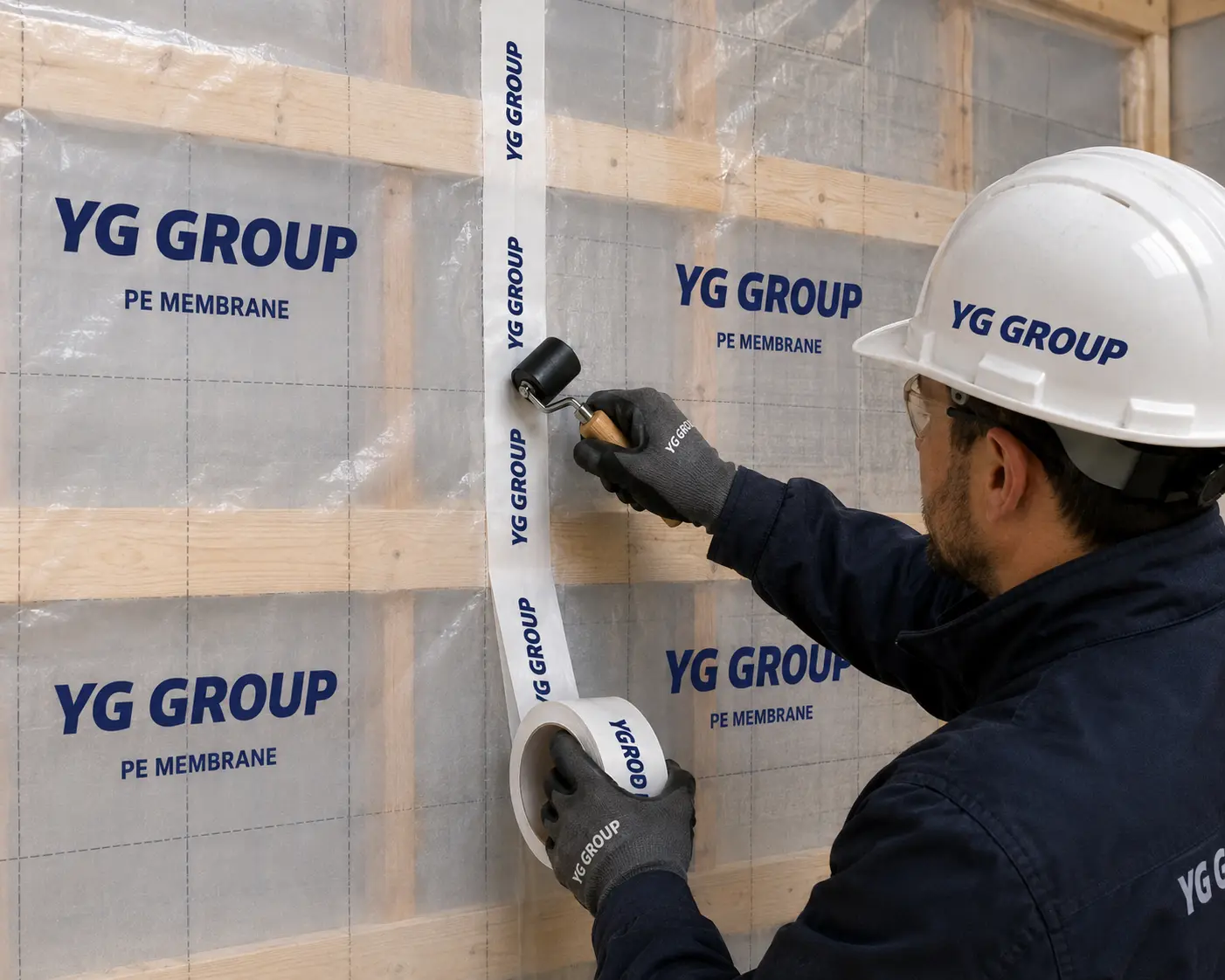
Vapor barrier tape should be applied to a clean, dry and compatible membrane with firm pressure across the complete seam.
Quick Selection Summary
Choose a vapor barrier tape that:
- Bonds reliably to the actual PE membrane
- Remains flexible during application
- Provides sufficient width on both sides of the seam
- Matches the expected temperature, moisture and exposure conditions
- Can be tested on the real membrane before full-scale installation
Key point: The same tape may perform differently on standard PE film, reinforced membranes, coated films, or textured surfaces. Always evaluate adhesion using the actual material.
What Is Vapor Barrier Tape?
Vapor barrier tape is a pressure-sensitive construction tape used to seal overlaps, joints, small punctures, and damaged areas in flexible vapor-control membranes.
Common applications include:
- Sealing PE membrane overlaps
- Joining polyethylene construction sheeting
- Repairing small cuts and punctures
- Sealing compatible flooring underlayment
- Supporting moisture-control systems in walls, floors and crawl spaces
Although “vapor barrier” is the commonly used term, "vapor retarder" is often more technically accurate. These materials reduce the rate of water vapor diffusion rather than necessarily stopping all vapor movement.
The correct use and position of a vapor-control layer depend on the climate, building structure, and project design. For additional background, see the U.S. Department of Energy guide to vapor barriers and vapor retarders.
Vapor barrier tape helps maintain continuity at membrane seams and repairs. However, the tape does not replace the membrane or independently certify the completed assembly as an air barrier or waterproofing system.
YG Group also provides a wider range of Building and Construction Adhesive Solutions for sealing, protection and repair applications.
What Should You Check When Choosing Vapor Barrier Tape?
Before selecting tape for vapor barrier seams, evaluate the following five factors.
| Selection factor | Why it matters | What to confirm |
|---|---|---|
| Membrane compatibility | PE, reinforced and coated films can have different surface properties | Test the tape on the actual membrane |
| Adhesion | Insufficient adhesion may cause edge lifting | Evaluate the initial bond and edge adhesion |
| Flexibility | Thin membranes may wrinkle or shift during installation | Choose a conformable backing |
| Exposure conditions | Temperature, moisture and sunlight may affect performance | Confirm the project environment and exposure period |
| Tape dimensions | Width and thickness affect seam coverage and handling | Match the tape to the overlap design |
The most important step is to test the tape on the actual membrane. This is especially important when the film is reinforced, embossed, coated, textured, or specially treated.
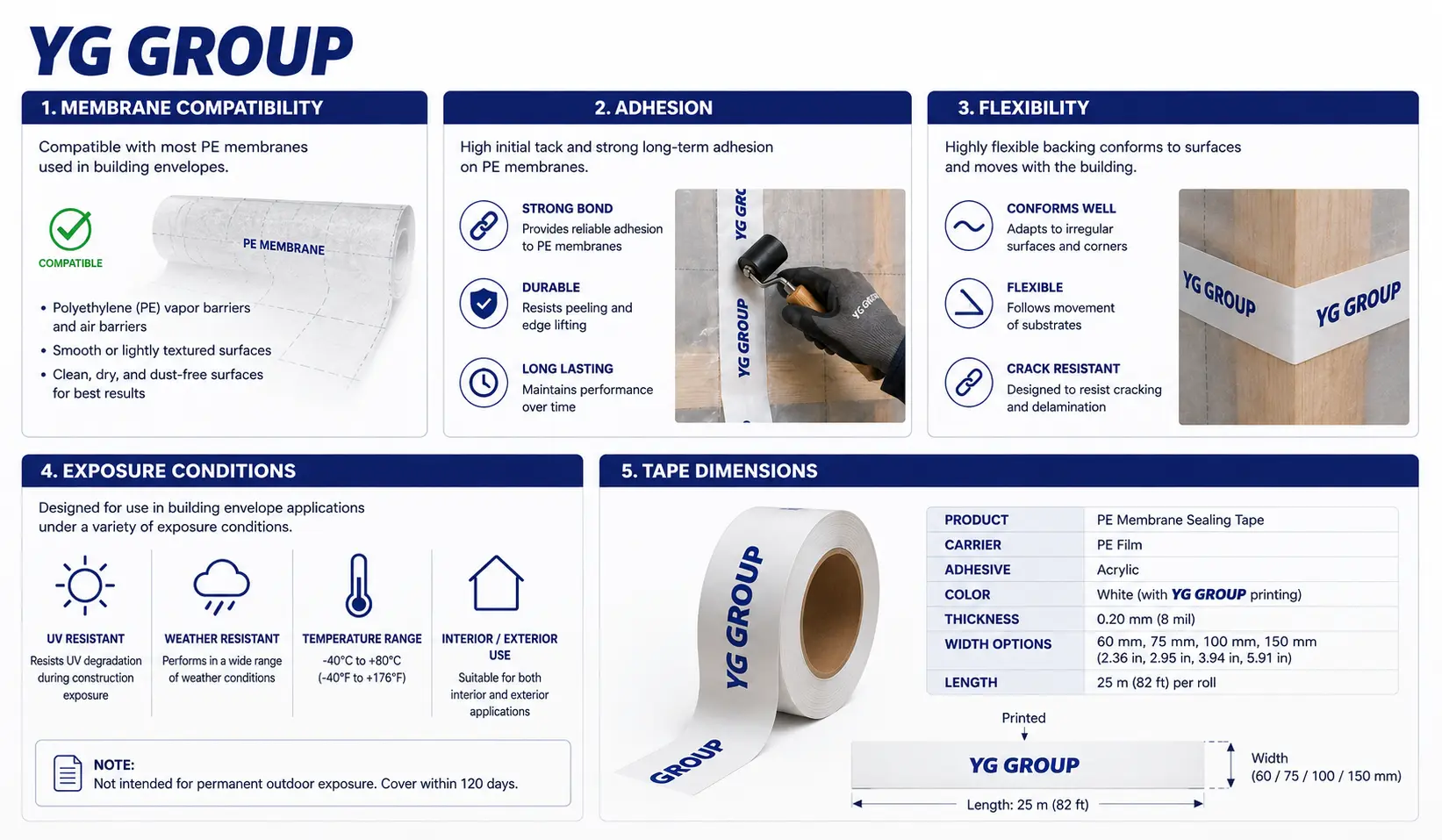
Membrane compatibility, adhesion, flexibility, exposure conditions and tape dimensions should all be evaluated before ordering.
PE2230 Vapor Barrier Tape Specifications
YG Group PE2230 combines a flexible PE film backing with hot melt pressure-sensitive adhesive.
| Property | Published specification |
| Product code | PE2230 |
| Backing | PE film |
| Adhesive | Hot melt adhesive |
| Total thickness | 220 ± 20 μm |
| Peel adhesion | ≥10 N/in |
| Tensile strength | ≥65 N/in |
| Elongation | ≥400% |
The moisture-resistant PE backing provides flexibility during application, while the hot melt adhesive offers initial adhesion to compatible plastic membranes.
The high elongation helps the tape conform to flexible sheeting during application. For moving or structural joints, a separately evaluated sealing system may be required.
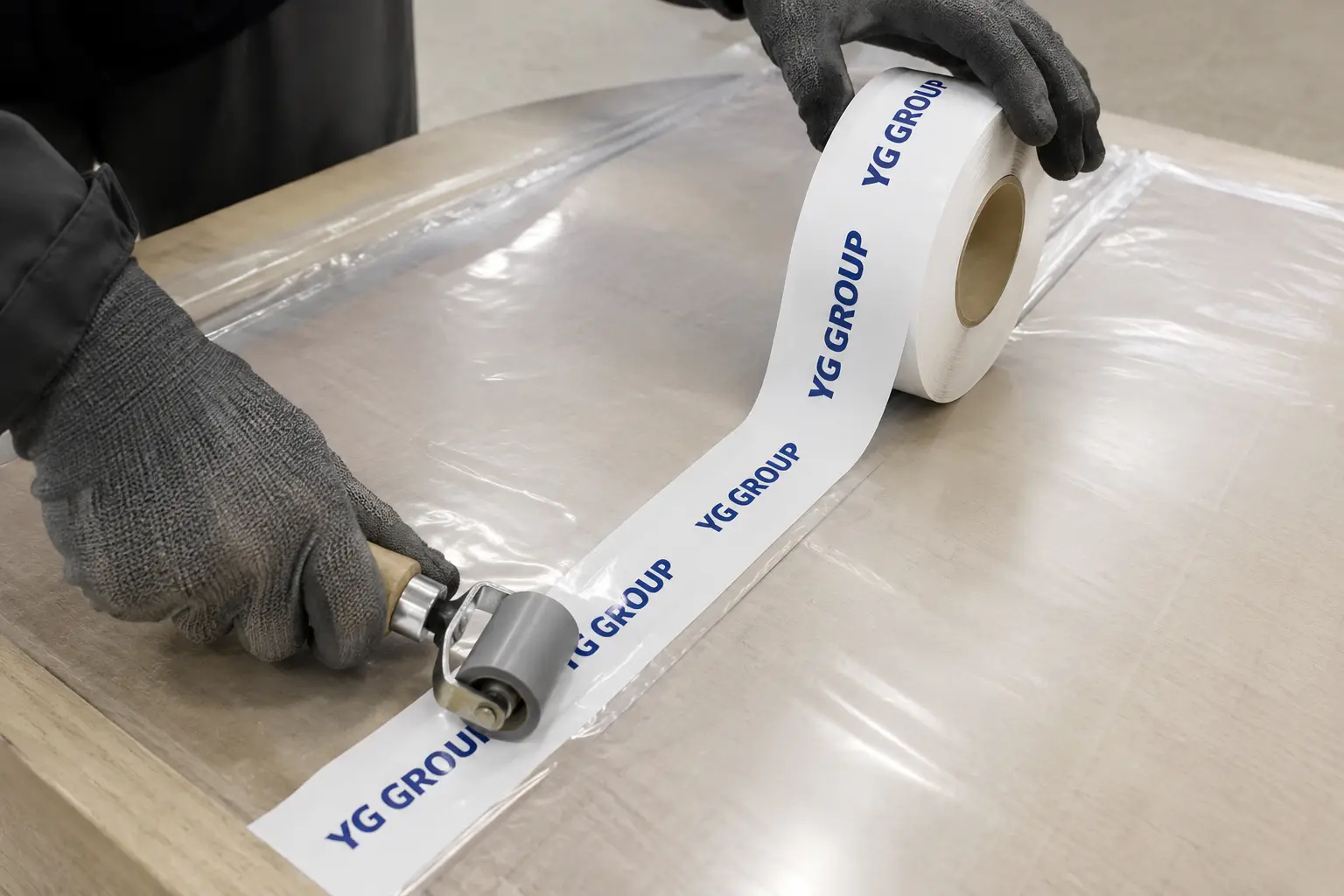
PE2230 applied to a clean PE membrane during an internal adhesion evaluation.
Where Can PE Vapor Barrier Tape Be Used?
PE Membrane Overlaps
The primary application is sealing overlaps between compatible polyethylene vapor barrier sheets.
The tape should provide sufficient contact area on both sides of the joint. The membrane should be positioned flat and should not be under excessive tension around the seam.
Plastic Sheeting Repairs
A plastic sheeting repair tape can cover small cuts, punctures, and tears in compatible PE film.
For larger damaged areas, place a suitable membrane patch over the opening and seal around all edges. The patch should extend beyond the damaged section to provide adequate contact area.
Crawl Space and Floor Membranes
PE sheeting may be used as part of a moisture-control system in crawl spaces, floors, and other building assemblies.
Vapor barrier sealing tape can be used for compatible sheet overlaps and minor repairs. Transitions around walls, columns, pipes, and service penetrations may require additional sealants, fasteners, or project-specific accessories.
Flooring Underlayment
Some flooring systems use PE or moisture-control underlayment beneath the finished floor.
Vapor barrier tape may be suitable for joining compatible underlayment seams. However, the instructions supplied by the flooring or underlayment manufacturer should take priority.
Tape thickness should also be considered where a raised seam could affect the finished floor.
What Should Buyers Confirm Before Ordering?
Membrane Type
Do not describe the material only as “plastic film.”
Confirm whether it is:
- Standard PE film
- Reinforced polyethylene
- Embossed or textured film
- Coated construction membrane
- Flooring underlayment
- Foil-faced or composite material
Surface treatments, additives, release agents, dust and contamination can affect adhesion.
Project Conditions
Provide information about:
- Installation temperature
- Service temperature
- Moisture exposure
- Temperature cycling
- Indoor or outdoor use
- Expected outdoor exposure period
- Whether the seam will remain exposed or be covered
Where outdoor exposure is expected, the required duration and actual climate conditions should be confirmed before use. “Moderate UV resistance” should not be treated as a defined long-term outdoor service life without supporting test conditions.
Tape Width and Roll Format
The tape should provide adequate adhesive contact on both sides of the membrane overlap.
A narrow tape may be difficult to center over an irregular or moving seam. A wider tape provides more coverage but may increase material use.
B2B buyers should also confirm whether they require:
- Finished rolls
- Custom widths
- Custom roll lengths
- Jumbo rolls for converting
- Printed tape
- Custom cores
- OEM packaging
- Private-label packaging
When Is Another Tape More Suitable?
Vapor barrier tape should not automatically be used for every construction joint.
Another material or additional testing may be required when:
- The surface is wet, oily, dusty or contaminated
- The substrate is rough or highly porous
- The joint is exposed to continuous water pressure
- Long-term direct sunlight exposure is expected
- Certified air-leakage performance is required
- A tested fire-rated assembly is required
- Significant structural movement must be accommodated
- The membrane manufacturer specifies another accessory
For temporary outdoor construction masking, surface protection, or bonding PE film to wood, metal, and coated surfaces, Stucco PE Tape may be more suitable.
Other specialty products are available in YG Group's Other Tapes and Tape Accessories category.
How to Apply Vapor Barrier Tape
Step 1: Test the Actual Membrane
Apply a short tape sample to the membrane that will be used in the project.
Check:
- Initial adhesion
- Edge lifting
- Surface damage
- Adhesive transfer
- Wrinkling around the seam
When possible, inspect the sample again after it has remained under the expected project conditions.
Step 2: Clean and Dry the Surface
Remove dust, oil, condensation, and loose particles.
Do not apply the tape to wet, frozen, dusty, oily, or loosely coated surfaces.
A pressure-sensitive adhesive cannot develop reliable contact if it bonds to contamination instead of the membrane.
Step 3: Position the Membrane
Arrange the sheets according to the overlap required by the membrane supplier or project design.
Remove excessive wrinkles and correct the membrane position before applying the tape.
Step 4: Apply the Tape Without Stretching
Center the tape over the membrane seam and unwind it gradually.
Do not stretch the tape during application. A stretched backing may pull back after installation and contribute to wrinkles or lifted edges.
Step 5: Apply Firm Pressure
Use a hand roller, squeegee, or firm manual pressure over the complete tape surface.
Pay particular attention to both tape edges to improve adhesive contact and reduce unbonded channels.
Step 6: Inspect Before Covering
Check the completed seam for:
- Lifted edges
- Wrinkles
- Air pockets
- Contaminated areas
- Incomplete overlaps
- Missed punctures
- Movement around penetrations
Complete any required repairs before covering the membrane with flooring, insulation, panels, or other finishing materials.
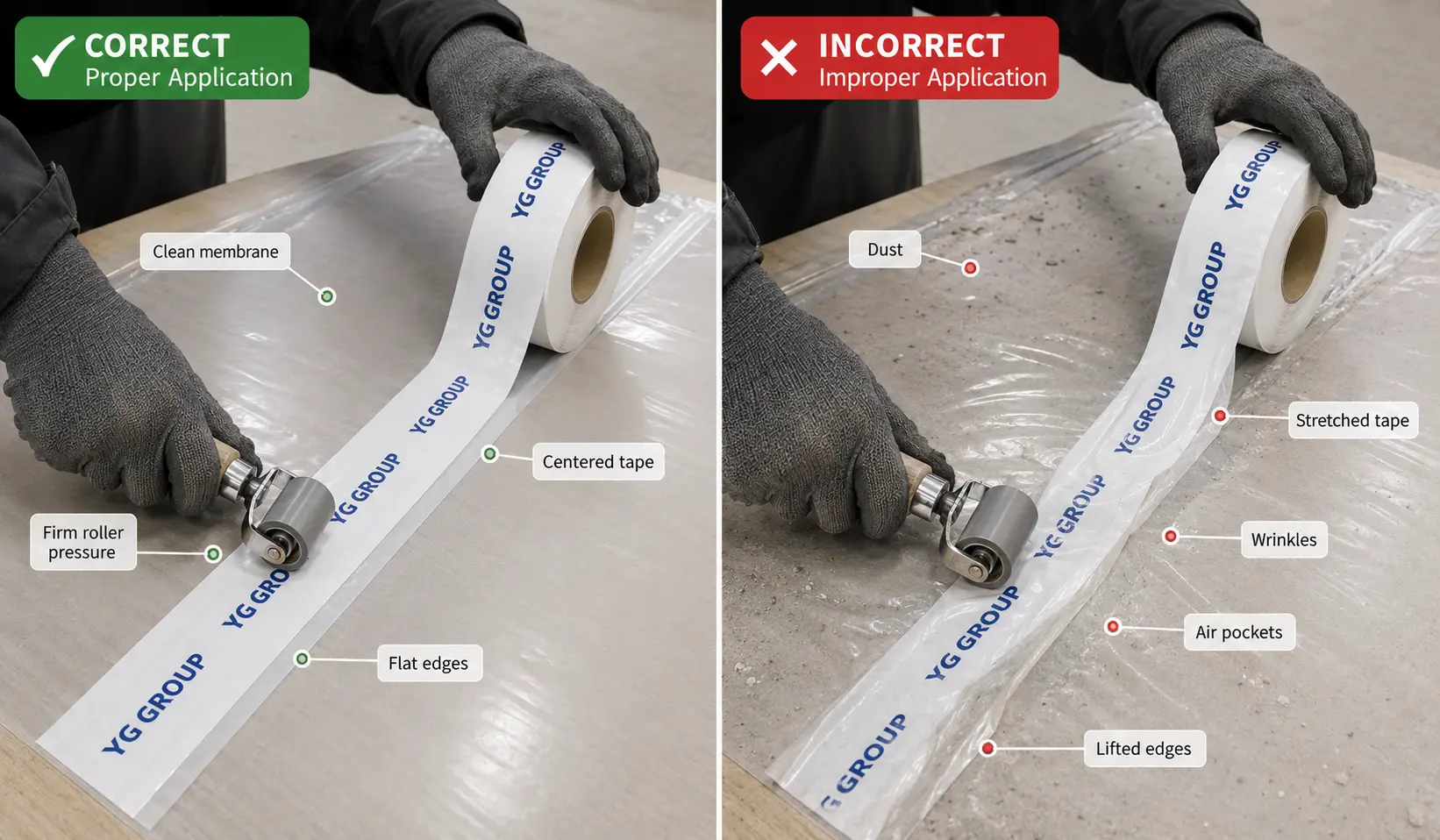
Correct application requires a clean membrane, centered tape, firm pressure, and fully bonded edges.
Vapor Barrier Tape vs. Other Construction Tapes
| Tape type | Typical use | Main consideration |
| Vapor barrier tape | PE membrane overlaps and repairs | Compatibility with flexible vapor-control membranes |
| Duct tape | General temporary repair and bundling | Adhesive aging and PE compatibility can vary |
| Sheathing tape | Exterior sheathing and weather-barrier joints | Must match the specified sheathing system |
| Butyl tape | Flashing and irregular sealing details | Usually thicker and more conformable |
| Aluminum foil tape | HVAC and foil-faced insulation | Designed for metal or foil-faced surfaces |
| Stucco PE tape | Temporary construction masking and protection | Intended for temporary construction applications |
The correct choice depends on the substrate, seam design, temperature, moisture exposure, required removal behavior, and applicable project standards.
Frequently Asked Questions
Is vapor barrier tape the same as air barrier tape?
Not necessarily.
A vapor retarder controls water vapor diffusion, while an air barrier controls air movement through a building assembly.
A tape or assembly should only be described as an air barrier when the required air-leakage performance has been verified.
Can duct tape be used on a vapor barrier?
General-purpose duct tape may initially adhere to plastic sheeting, but its adhesive aging, backing stability and PE membrane compatibility can vary.
A tape specifically selected for compatible vapor-control membranes is generally more suitable for concealed or long-term membrane seaming applications.
Does vapor barrier tape stick to concrete or wood?
PE2230 is primarily designed for compatible membranes and plastic sheeting.
Concrete, wood and masonry can be porous, dusty or uneven. Direct bonding to these substrates requires an application test and may also require primer, sealant or mechanical fastening.
Why Source Vapor Barrier Tape from YG Group?
YG Group is a global adhesive materials manufacturer serving B2B customers across construction, packaging, labeling, automotive and industrial markets.
Available customization options include:
- Tape width and roll length
- Total thickness
- Tape color
- Printing and logo
- Adhesive type
- Core size
- Industrial or retail packaging
- Jumbo roll supply
- Finished roll supply
- OEM and private-label production
YG Group manufactures products according to confirmed order specifications rather than maintaining standard retail inventory.
MOQ depends on dimensions, thickness, color, packaging, and customization requirements. For first orders, the total order value is generally expected to exceed USD 5,000.
Samples can be arranged for membrane compatibility and adhesion evaluation before bulk production. Sample freight is normally paid by the customer.
Request a Sample or Quotation
To receive an initial recommendation, please provide:
- Membrane material
- Application
- Indoor or outdoor use
- Required width and roll length
- Estimated quantity
- Destination country
Additional technical, testing, and packaging requirements can be confirmed after the initial inquiry.
Contact YG Group to request a PE2230 sample or a customized vapor barrier tape quotation.
Written by: YG Group Marketing Team
Product reference: PE2230 Vapor Barrier Tape
Last updated: June 2026