

Recycled BOPP Tape for Packaging: What Buyers Should Know



Switching from conventional packaging tape to a recycled-content alternative involves more than comparing recycled percentages.
For packaging buyers, the real question is whether recycled BOPP tape can reduce reliance on virgin polypropylene while still meeting the mechanical, adhesive, and processing requirements of the existing carton-sealing operation.
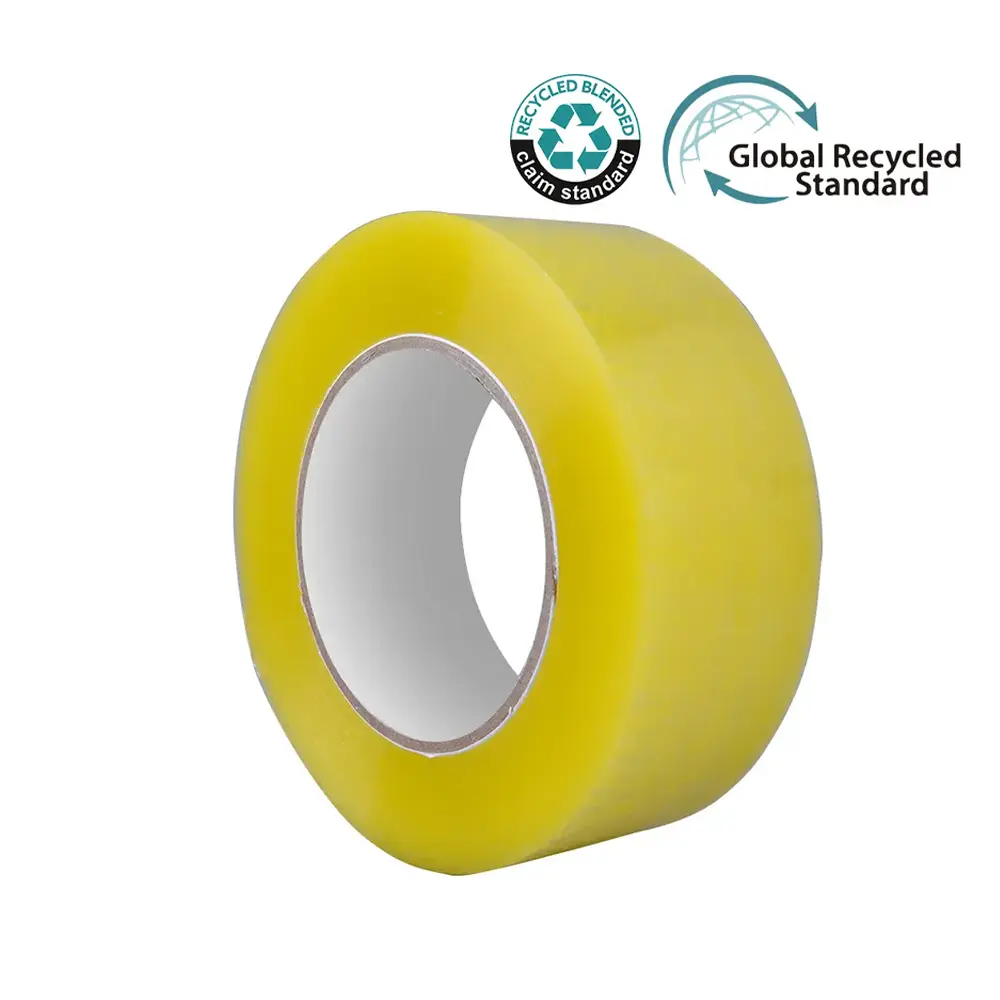
YG GROUP's Recycled BOPP Tape model R-BPC043 uses recycled PP film with a water-based adhesive and is designed for carton sealing, logistics, industrial packing, and retail distribution.
Recycled-content tape can be particularly relevant for companies looking to reduce virgin plastic use, support recycled-material procurement targets, or evaluate alternative materials for high-volume packaging operations.
However, recycled content should always be considered together with technical performance and actual application suitability.
Quick Answer: Recycled BOPP Tape incorporates recycled polypropylene into the BOPP film backing instead of relying entirely on virgin PP. Before replacing conventional BOPP tape, buyers should check recycled-content documentation, peel adhesion, tensile strength, elongation, carton compatibility, application conditions, and actual trial performance. Recycled content and recyclability should also be evaluated separately.

What Is Recycled BOPP Tape?
Recycled BOPP Tape is a pressure-sensitive packaging tape that incorporates recycled polypropylene into its film backing.
BOPP stands for biaxially oriented polypropylene, a common backing material for carton sealing tapes because of its combination of strength, flexibility, and practical packaging performance.
The primary material difference between conventional and recycled-content constructions is the source of part of the polypropylene used in the film.
YG GROUP R-BPC043 uses:
Recycled PP (RPP) Film
↓
Water-Based Adhesive
The recycled PP reduces dependence on virgin polypropylene while retaining the familiar structure and application format of BOPP packaging tape.
For buyers, however, recycled content is only one part of the specification.
A commercially suitable tape still needs to meet the requirements of the actual carton, sealing process, storage conditions, and transportation environment.

Does Recycled Content Affect Tape Performance?
Recycled content alone does not determine whether a packaging tape will perform well.
The more useful approach is to evaluate the technical specifications of the actual product and then verify them in the intended application.
YG GROUP R-BPC043 is designed to provide strength, clarity, and adhesion comparable to conventional BOPP film tape while incorporating recycled polypropylene.
Its current specifications include:
| Specification | R-BPC043 |
| Backing | Recycled PP (RPP) Film |
| Adhesive | Water-Based |
| Total Thickness | 43 μm |
| Peel Adhesion | ≥4.0 N/in |
| Tensile Strength | ≥76 N/in |
| Elongation | ≥100% |
These values provide measurable criteria for evaluating the tape rather than relying only on terms such as “recycled” or “sustainable.”
Peel adhesion indicates adhesive performance, while tensile strength and elongation describe the mechanical behavior of the tape backing. These values provide a technical baseline, but actual carton-sealing performance should still be verified on the intended carton and under real application conditions.
What Should You Check Before Replacing Conventional BOPP Tape?
Replacing an existing BOPP packaging tape should be treated as a material-change project rather than an automatic one-to-one substitution.
Before switching to a recycled BOPP tape, buyers should evaluate the following factors.
1. Carton Surface
The corrugated board itself can significantly affect adhesive performance.
Confirm whether the tape will be applied to:
- Standard corrugated cartons
- High-recycled-content board
- Rough or highly fibrous surfaces
- Printed cartons
- Coated cartons
- Dusty packaging surfaces
Whenever possible, evaluate the tape on the same carton grade used in normal production.
2. Application Method
Confirm whether the tape will be applied:
- Manually
- With a handheld dispenser
- Through semi-automatic equipment
- Through an automatic carton-sealing line
For machine applications, buyers should also evaluate unwind behavior and processing stability rather than looking only at adhesion.
3. Application and Storage Temperature
Pressure-sensitive adhesive performance can change with temperature.
Separate two conditions:
Application temperature—the temperature when the tape is first applied.
Service or storage temperature—the temperature the sealed carton experiences afterward.
This is particularly relevant for export shipments, warehouses, seasonal temperature changes, and long-distance logistics.
4. Mechanical and Adhesive Specifications
Compare the recycled-content tape with the existing tape using measurable parameters such as
- Total thickness
- Peel adhesion
- Tensile strength
- Elongation
- Adhesive type
- Film construction
These values provide a technical baseline before trial testing.
5. Actual Packaging Trials
Laboratory specifications cannot reproduce every packaging condition.
Before a high-volume conversion, test the tape using:
- Actual carton grades
- Existing dispensers or sealing equipment
- Normal application pressure
- Representative package weights
- Typical storage conditions
Check for:
- Edge lifting
- Poor carton contact
- Tape breakage
- Unstable unwind
- Seal failure after storage
The objective is not simply to find a tape containing recycled material.
It is to find a recycled-content construction that also works reliably in the existing packaging process.
How Should Recycled Content Be Verified?
For B2B procurement, a general statement such as “contains recycled material” may not provide enough information.
Buyers may need evidence showing how recycled material is verified and traced through the supply chain.
Two commonly referenced systems are the Global Recycled Standard (GRS) and Recycled Claim Standard (RCS).
Both support verification and chain-of-custody tracking of recycled materials, although their scopes and detailed requirements differ.
YG GROUP offers recycled BOPP tape options associated with:
- GRS: ≥20% recycled content
- RCS: ≥5% recycled content
The actual recycled-content percentage, certification scope, and supporting documentation should be confirmed for the exact grade and order requirement.
A more useful purchasing question is therefore
What recycled-content percentage is available for this grade, where is the recycled material used, and what documentation can support the claim?
For detailed certification requirements, buyers should refer to the official Global Recycled Standard (GRS) and Recycled Claim Standard (RCS) information from Textile Exchange.
Recycled Content vs. Recyclability: What Is the Difference?
These terms describe different parts of the material lifecycle and should not be used interchangeably.
Recycled content describes material that has already been recovered and incorporated into a new product.
For recycled BOPP tape, this refers to recycled polypropylene incorporated into the film backing.
Recyclability asks whether the finished product can be effectively collected, sorted, processed, and recycled after use.
That can depend on:
- The complete tape construction
- Adhesive system
- Packaging combination
- Collection infrastructure
- Sorting technology
- Recycling processes
- Local waste-management systems
Therefore:
Recycled PP content does not automatically mean that the finished tape is recyclable in every recycling system.
This distinction is especially important when preparing sustainability claims, product declarations, or customer questionnaires.
What Should Buyers Know About PPWR and Recycled Content?
The EU Packaging and Packaging Waste Regulation, Regulation (EU) 2025/40, increases the importance of recycled-content requirements for plastic packaging.
However, requirements can vary according to packaging category, material source, applicable calculation rules, exemptions, and implementation requirements.
The presence of recycled polypropylene in a tape should therefore not automatically be translated into a claim such as “PPWR compliant.”
Packaging buyers should instead evaluate the applicable requirements for the complete packaging system and confirm the recycled-content level and documentation required for their specific case.
Recycled BOPP tape can support a broader recycled-material packaging strategy, but regulatory compliance should be assessed separately.
For specific requirements, buyers should refer to the official EU Packaging and Packaging Waste Regulation (PPWR) text.
Recycled BOPP Tape Buyer Checklist
Before requesting a quotation or sample, provide enough information for the supplier to understand the actual packaging application.
Tape Specification
- Required width
- Roll length
- Total thickness
- Color
- Printing requirements
- Core size
- Packaging requirements
Carton Information
- Corrugated board type
- Surface condition
- Package weight
- Box dimensions
- Recycled-fiber content, if relevant
Application Conditions
- Manual or machine application
- Application temperature
- Storage temperature
- Transportation environment
- Required sealing duration
Recycled-Content Requirements
- Target recycled-content percentage
- GRS or RCS requirements
- Required supporting documents
- Pre-consumer or post-consumer requirements, if applicable
Target Market
If the packaging will be used in a regulated market, provide the destination and any relevant packaging requirements during material evaluation.
A complete RFQ helps the supplier recommend the appropriate tape based on the actual application rather than only on roll dimensions or recycled-content percentage.
FAQ
What Is the Difference Between Recycled BOPP Tape and Conventional BOPP Tape?
The primary difference is the source of part of the polypropylene used in the film.
Recycled BOPP tape incorporates recycled PP, while conventional BOPP tape generally relies more heavily on virgin polypropylene.
Both still need to meet the required adhesive and mechanical performance.
Can Recycled BOPP Tape Replace Conventional Packing Tape?
Potentially, but it should be tested first.
Compare the recycled-content tape with the existing product using actual cartons, application equipment, storage conditions, and required performance before making a large-scale change.
Can Recycled BOPP Tape Support GRS or RCS Requirements?
YG GROUP offers recycled-content options associated with GRS and RCS requirements.
The recycled-content percentage, certification scope, and supporting documentation should be confirmed for the exact product grade and order.
Does Recycled Content Mean the Tape Is Recyclable?
No.
Recycled content describes the source of material used to manufacture the tape.
Recyclability depends on the complete tape construction, packaging system, available collection infrastructure, and recycling process.
Is Recycled BOPP Tape Automatically PPWR Compliant?
No.
The presence of recycled polypropylene alone does not establish PPWR compliance.
The final packaging system, applicable category, recycled-content requirements, documentation, and relevant regulatory provisions need to be evaluated separately.
Conclusion
Recycled BOPP tape can help packaging buyers introduce recycled polypropylene into routine carton-sealing operations while reducing reliance on virgin PP.
But recycled content should not be evaluated in isolation.
A successful transition from conventional BOPP tape depends on four factors:
- Documented recycled content
- Defined technical performance
- Compatibility with the actual carton and application process
- Successful application testing
YG GROUP R-BPC043 combines recycled PP film with a water-based adhesive and provides defined specifications for thickness, peel adhesion, tensile strength, and elongation.
For procurement teams, the most useful question is therefore not simply
How much recycled PP does the tape contain?
It is:
Does the recycled-content construction meet our packaging performance requirements, can its recycled content be documented, and has it been tested in our actual carton-sealing process?
If you are evaluating a replacement for conventional BOPP packaging tape, YG GROUP can support sample evaluation based on carton type, roll specifications, application conditions, recycled-content targets, and certification requirements.