


YG Group Jiangxi Base Included in 2026 Excellent-Level Smart Factory Publicity List



YG Group has reached a new milestone in smart manufacturing.
In October 2026, Jiangxi Yongguan Technology Development Co., Ltd. was included in China's publicized list of proposed 2026 Excellent-Level Smart Factory projects.
The project is titled:
Flexible Smart Factory for High-Performance Adhesive Materials Supporting Agile Global Delivery
The project reflects a clear manufacturing goal:
Use digital systems, automation and AI to support stable quality, flexible production and better global delivery coordination.
Quick Answer: What Makes the Jiangxi Base a Smart Factory?
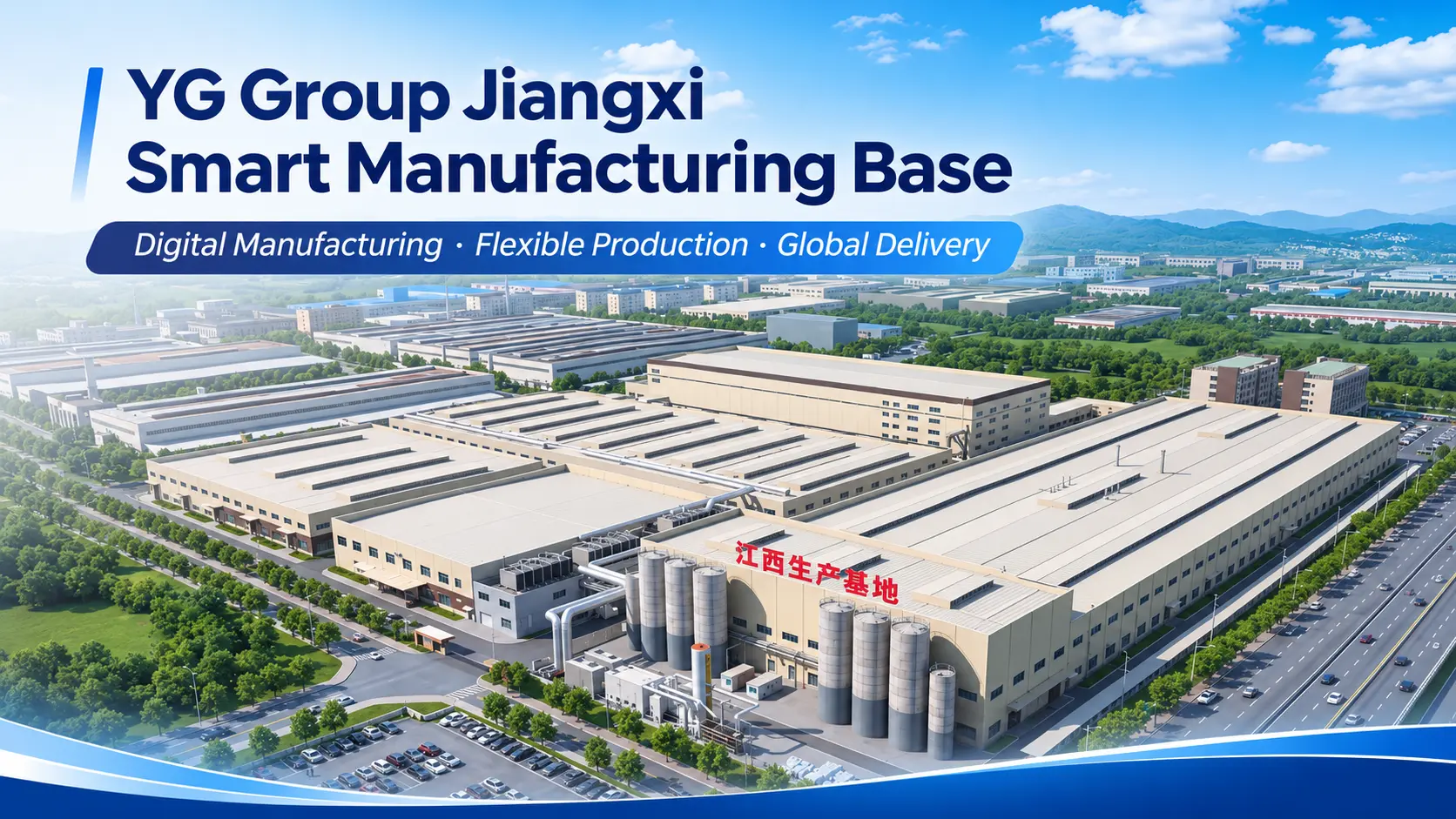
YG Group's major integrated manufacturing base in Jiangxi connects digital technology with real production.
Four capabilities form the core of this smart manufacturing model:
| Capability | What It Supports |
|---|---|
| Connected Digital Systems | Production visibility and traceability |
| AI-Assisted Inspection | Faster quality monitoring |
| Smart Warehousing | Better material and inventory control |
| Flexible Manufacturing | Faster response to changing order needs |
Together, these capabilities connect:
R&D → Planning → Production → Quality → Warehousing → Delivery
For customers, the value is practical:
Production Stability · Better Traceability · Flexible Manufacturing · Better Delivery Coordination
What Is an Excellent-Level Smart Factory?
Excellent-Level Smart Factory projects focus on advanced smart manufacturing and deeper digital integration.
They connect production equipment, manufacturing systems, quality data, warehousing and management.
For adhesive manufacturing, this matters because coating, drying, tension and converting all affect the final product.
Better data flow can therefore support better process control.
How YG Group Connects Digital Manufacturing
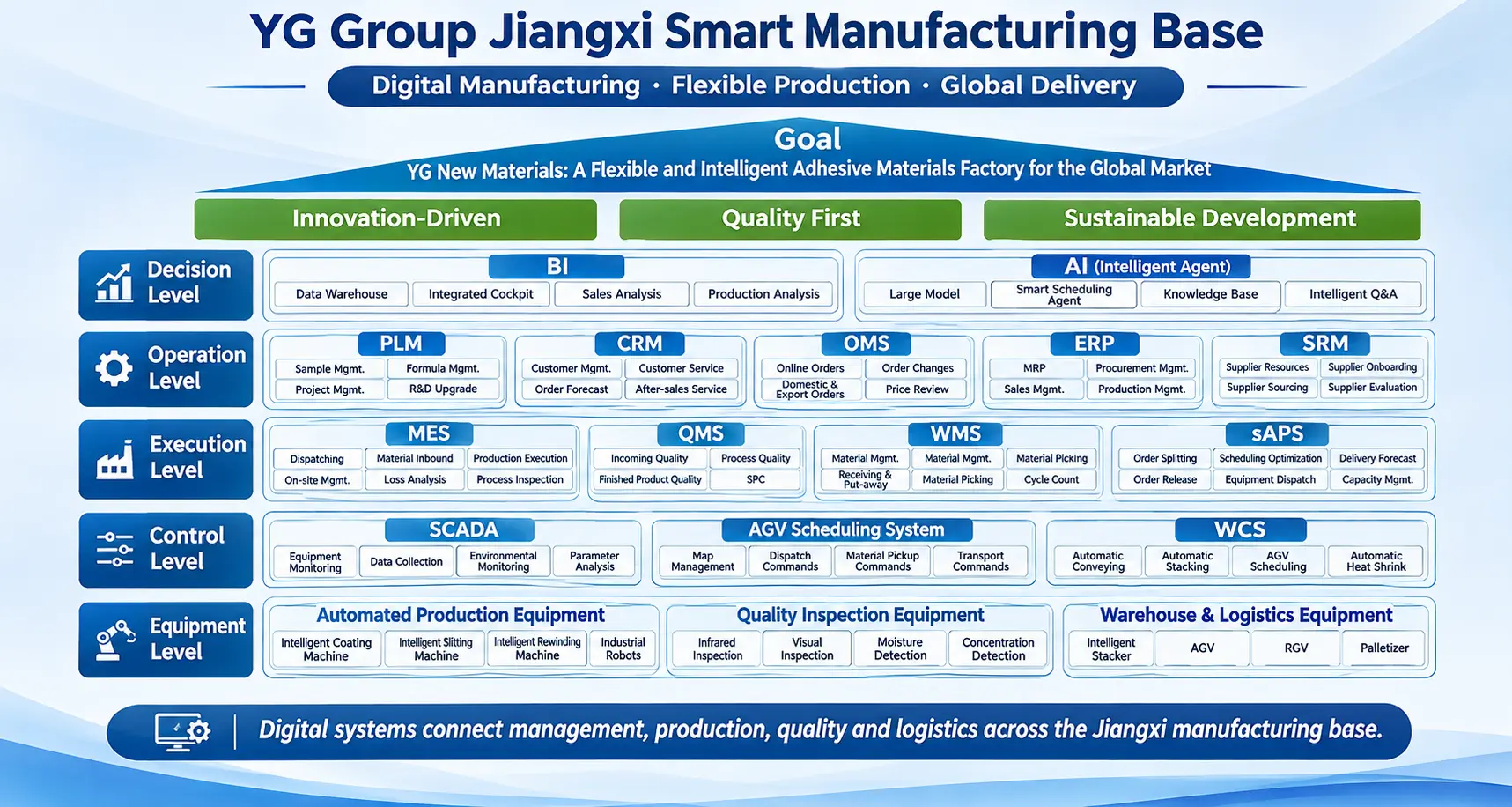
The Jiangxi base connects more than 20 information systems across factory operations.
These include:
PLM · CRM · ERP · SRM · MES · WMS · QMS · SCADA
For example:
- PLM connects product and technical data
- MES tracks production execution
- QMS supports quality management
- WMS manages warehouse operations
- ERP supports resource planning
However, the number of systems is not the main point.
The real value comes from connecting information across teams and production stages.
This supports:
Better Visibility → Better Traceability → Faster Coordination → Better Decisions
For more background, see YG Group Smart Manufacturing and Digital Transformation.
Smart Manufacturing in Practice
Digital systems only create value when they improve real production.
At the Jiangxi base, smart manufacturing supports several practical areas.
AI-Assisted Visual Inspection
AI vision supports selected quality-control processes.
In applicable AI vision inspection scenarios, recognition precision can reach 0.1 mm.
This does not mean every inspection uses the same precision. It shows how AI can support specific production checks.
SPC Quality Monitoring
SPC-based analysis tracks key quality indicators.
It helps production teams identify unusual trends earlier and respond more quickly.
Smart Production Scheduling
Digital planning links production demand with available factory resources.
This supports faster adjustment when specifications or order priorities change.
Smart Warehousing and Material Handling
Digital warehouse systems support:
- Material identification
- Inventory location
- Inbound and outbound operations
- Automated material movement
The Jiangxi base has implemented 17 intelligent manufacturing applications across production and operations.
Together, they support a more connected factory.

What Does Smart Manufacturing Mean for Customers?
For global buyers, smart manufacturing should create clear business value.
The most important benefits are not software names or robots.
They are the results behind those systems.
1. More Stable Production
Digital monitoring gives teams better visibility into key process conditions.
This can support more stable production and better batch consistency.
2. Better Traceability
Connected systems can link:
Raw Materials → Production → Quality → Warehousing → Batch Records
This helps with technical review, quality follow-up and supplier audits.
3. More Flexible Manufacturing
Adhesive-material customers often need different:
- Adhesive systems
- Product structures
- Widths and lengths
- Packaging formats
- Order quantities
Digital planning helps teams coordinate these changes more efficiently.
4. Better Delivery Coordination
Production and inventory visibility helps teams plan orders more clearly.
It also improves coordination between production, warehousing and export schedules.
5. Faster Problem Analysis
Connected production and quality data gives technical teams more information when a problem occurs.
This can support faster analysis and continuous improvement.
Digital Quality Control Across Production
Quality control remains a core part of adhesive manufacturing.
At the Jiangxi base, digital systems support:
-
Raw material inspection
-
Process monitoring
-
In-process quality checks
-
Finished-product inspection
-
Batch recording
-
Quality traceability
YG Group also operates a CNAS-accredited testing center.
Its testing capabilities cover adhesive-material evaluation and key performance testing.
Factory data and laboratory testing serve different roles.
Together, they support a more complete quality-management process.
For more information, see YG Group Earns CNAS Accredited Laboratory Status.
Innovation Behind the Jiangxi Smart Factory
Smart manufacturing needs more than equipment and software.
It also needs technical knowledge and continuous improvement.
Jiangxi Base · As of 2026
- 37 patents
- 20 software copyrights
- 10+ management-system certifications
- 20 intelligent manufacturing solutions
These figures refer specifically to the Jiangxi base.
They show how the site combines manufacturing experience with digital tools and process knowledge.
Supporting Agile Global Delivery
Global adhesive-material orders often involve different materials, roll sizes, packaging formats and delivery schedules.
Digital planning gives teams better visibility into:
Capacity · Inventory · Production Status · Order Progress
This helps coordinate customized, mixed-SKU and repeat orders more efficiently.
Smart manufacturing therefore supports both production and global supply-chain coordination.
Part of YG Group's Global Manufacturing Network
The Jiangxi site is YG Group's major integrated manufacturing base in Jiangxi.
It forms part of a wider manufacturing network serving global adhesive-material customers.
YG Group operates manufacturing and operational sites in:
- Shanghai
- Jiangxi
- Shandong
- Vietnam
- Malaysia
For more information, visit YG Group Global Plants.
From Automation to Intelligent Manufacturing
YG Group continues to move from individual automation toward more connected manufacturing.
The next stage focuses on:
- Deeper system integration
- More flexible production
- Wider AI applications
- Stronger digital quality control
- Smarter warehousing
- Better production data analysis
The goal remains practical:
Build a more flexible, stable and responsive adhesive-material manufacturing system for global customers.
Smart manufacturing should ultimately support better products, clearer data and better delivery coordination.
Frequently Asked Questions
What is the YG Group Jiangxi Smart Factory project?
The project is titled Flexible Smart Factory for High-Performance Adhesive Materials Supporting Agile Global Delivery.
Jiangxi Yongguan Technology Development Co., Ltd. was included in China's proposed 2026 Excellent-Level Smart Factory publicized list.
What is the current status of the project?
As of November 6, 2026, the project appears in the official publicized proposed-project list.
YG Group therefore describes it as included in the publicity list, rather than as a final award.
What digital systems does the Jiangxi factory use?
The factory connects more than 20 information systems.
Examples include PLM, ERP, MES, WMS, QMS and SCADA.
How does AI support adhesive manufacturing?
AI supports selected areas such as visual inspection and production analysis.
In applicable AI vision inspection scenarios, recognition precision can reach 0.1 mm.
What does smart manufacturing mean for customers?
It can support:
- More stable production
- Better traceability
- Flexible manufacturing
- Better delivery coordination
- Faster problem analysis
Does YG Group use smart warehousing?
Yes.
The Jiangxi base uses digital warehouse management and automated material-handling applications.
Building a Smarter Adhesive Materials Supply System
Smart manufacturing is not only about automation.
For YG Group, it connects:
R&D → Manufacturing → Quality → Warehousing → Delivery
The Jiangxi base combines digital systems, AI, automation and adhesive-process knowledge.
This supports a more flexible manufacturing system for global customers.
Status note: As of November 6, 2026, the project is described in official public information as part of the proposed Excellent-Level Smart Factory publicity list.