

How to Choose Adhesives for Self-Adhesive Labels



Choosing an adhesive for a self-adhesive label is not simply about finding the product with the highest tack or peel adhesion.
The adhesive needs to match the actual substrate, surface condition, labeling temperature, service environment and required removal behavior.
A label that performs well on clean glass at room temperature may behave very differently on an untreated HDPE bottle, a dusty corrugated carton or a package labeled inside a freezer.
A practical adhesive-selection process should start with five questions:
- What material will the label be applied to?
- What is the actual surface condition?
- At what temperature will labeling take place?
- What temperatures will the label experience afterward?
- Should the label be permanent, removable or designed for a wash-off process?
For removable applications, also confirm the expected dwell time before removal, because adhesive bond strength can develop over time.
YG Group works with multiple pressure-sensitive adhesive systems across paper, synthetic paper and film label constructions, including water-based, hot-melt, freezer-grade hot-melt and solvent-based systems.
Quick Answer: Which Label Adhesive Should You Evaluate First?
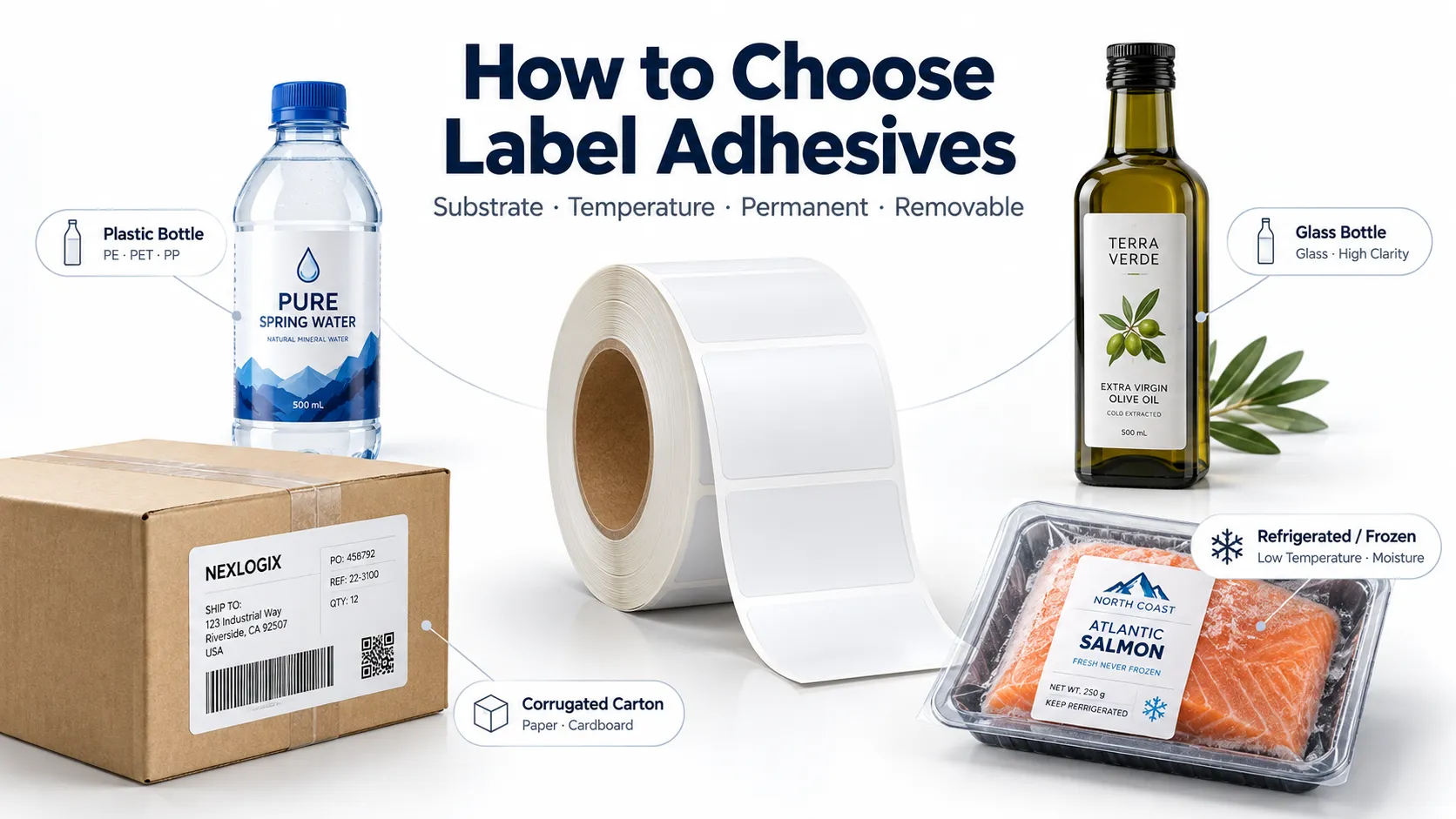
The table below gives starting directions only. The final adhesive grade should be tested on the actual substrate and within the complete label construction.
| Application Situation | Starting Direction |
|---|---|
| Clean glass or metal at room temperature | A general permanent adhesive may be evaluated |
| Untreated PE or PP | Evaluate a grade designed for lower-surface-energy plastics |
| Label applied in cold conditions | Evaluate a low-temperature or freezer-grade adhesive |
| Product frozen after room-temperature labeling | Confirm low-temperature service performance |
| Temporary promotion | A removable adhesive may be evaluated |
| Returnable bottle washing | Evaluate a wash-off adhesive system |
| Rough or dusty carton | Evaluate a grade suited to the actual board surface |
For removable labels, the expected dwell time should also be included in the test plan.
Start with the Complete Label Construction
A pressure-sensitive label typically consists of:
Facestock + Adhesive + Release Liner
The facestock affects printing, appearance, stiffness and flexibility.
The adhesive determines how the label bonds to the package.
The release liner affects die-cutting, dispensing, converting and application.
This is why adhesive selection cannot be separated from the rest of the label construction.
For example, a stiff PET facestock wrapped around a small-diameter bottle can create much greater edge stress than a flexible PE facestock applied to a squeezable container.
YG Group's current label portfolio combines different facestocks with different adhesive and liner systems rather than treating adhesive as a stand-alone specification. For example, current sheet-label constructions include semi-gloss paper paired with water-based, hot-melt or freezer-grade hot-melt adhesives, while PET matt silver is available with solvent-based adhesive.
Buyers can review the broader Self-Adhesive Label Materials range.
1. Match the Adhesive to the Actual Substrate
The first technical question should be:
What surface will the adhesive actually contact?
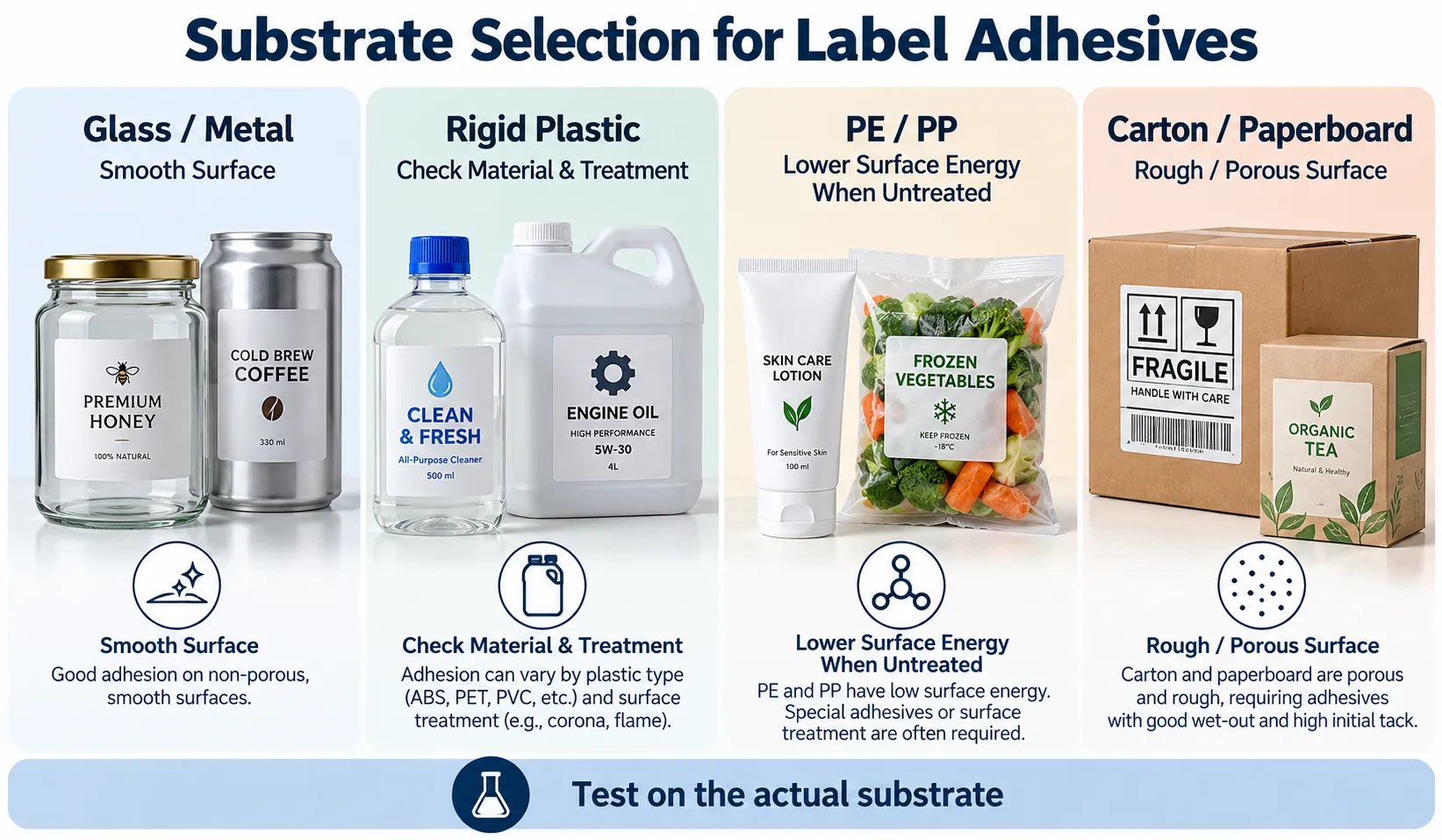
Glass and Metal
Clean glass and metal generally provide relatively consistent bonding surfaces.
But performance can still change because of:
- Condensation
- Oil
- Cleaning agents
- Coatings
- Temperature
For transparent labels, adhesive clarity also affects the final visual appearance.
PET and Other Rigid Plastics
Rigid plastics are widely used in beverages, cosmetics, food and household packaging.
The polymer name alone is not enough to select an adhesive.
Buyers should also consider:
- Surface treatment
- Bottle curvature
- Contamination
- Label size
- Filling conditions
- Service environment
Untreated PE and PP
Untreated PE and PP generally have lower surface energy than glass or metal, which can make adhesive wet-out more difficult.
Typical examples include:
- HDPE bottles
- PP containers
- Flexible PE packaging
- Squeezable bottles
Corona, flame or other surface treatments can change the bonding condition, so testing should use the customer's actual container whenever possible.
Carton and Paperboard
Paper and corrugated board can vary significantly in:
- Roughness
- Porosity
- Recycled fiber content
- Dust
- Coating
A label that performs well on smooth coated paperboard may not behave the same way on rough recycled corrugated board.
YG Group Technical Note: Test the Real Surface, Not Only a Standard Panel
Laboratory data such as peel adhesion and initial tack are useful for comparing adhesive constructions, but they do not fully replace application testing.
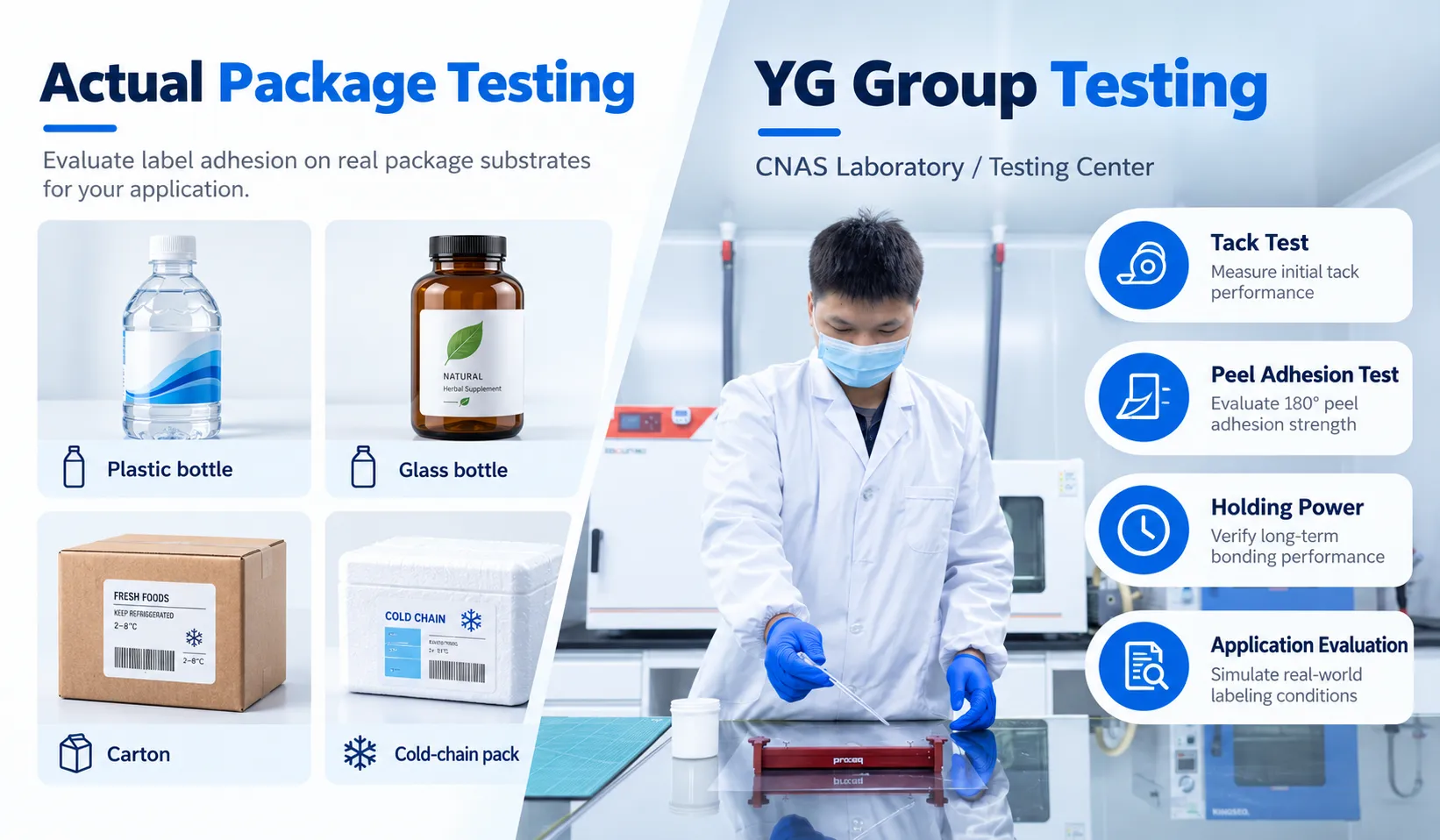
YG Group operates a CNAS-accredited testing center that evaluates adhesive properties including tack, peel strength, holding power and tensile performance. Its Application Center also evaluates adhesive materials under conditions involving heat, humidity, aging and UV exposure.
For a new label project, the most useful test sequence is:
Laboratory Performance → Actual Substrate → Actual Label Construction → Intended Environment
This is especially important for untreated plastics, small-diameter containers, cold-chain packaging and removable applications.
2. Separate Application Temperature from Service Temperature
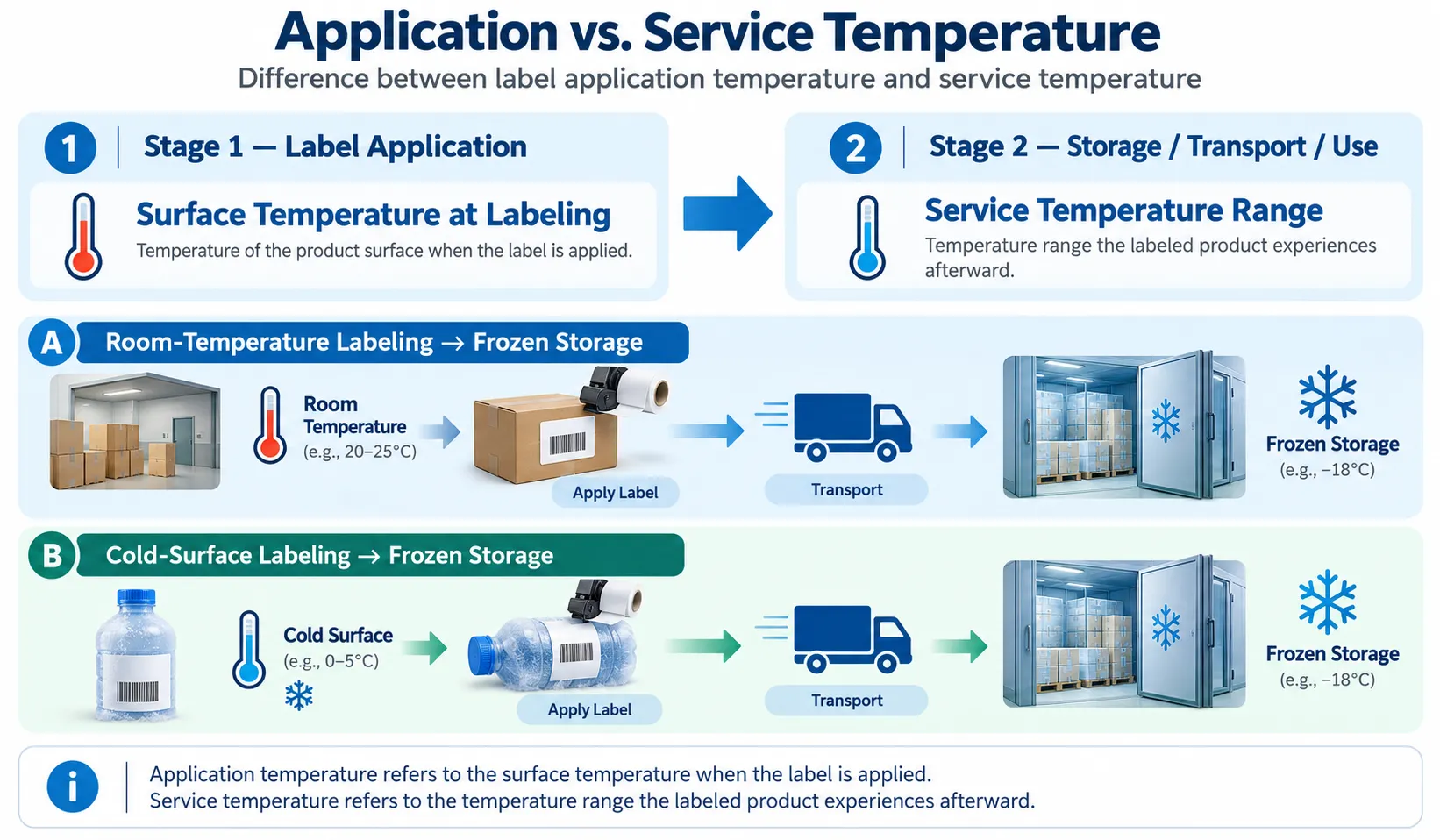
One of the most common mistakes in label selection is treating application temperature and service temperature as the same thing.
Application temperature is the temperature of the substrate and label when labeling takes place.
Service temperature is the temperature range the label experiences afterward during storage, transport and use.
Consider two freezer applications:
Scenario A
A label is applied to a dry carton at room temperature, and the product is frozen afterward.
Scenario B
A label is applied directly to a refrigerated or frozen package.
These applications may require different adhesive behavior because Scenario B requires the adhesive to establish suitable initial contact at a lower temperature.
YG Group Cold-Chain Example
YG Group's current Cold Chain Label Materials include:
- Semi-gloss paper
- Thermal paper
- Synthetic paper
- Gloss white PP
with adhesive options including:
- Low-temperature hot melt
- Freezer-grade hot melt
- Freezer-grade water-based adhesive
One current construction uses 60 μm Gloss White PP with freezer-grade hot-melt adhesive and a white glassine liner.
This illustrates why a buyer should not simply request a “freezer adhesive.”
Instead, provide:
Application temperature: ___°C
Service temperature: ___°C to ___°C
The supplier can then evaluate both the adhesive and the complete construction.
3. Permanent, Removable or Wash-Off?
These requirements describe different adhesive behaviors and should be specified separately.
Permanent Adhesive
Permanent adhesive is intended to maintain a long-term bond during the expected life of the label.
Typical applications include:
- Product identification
- Logistics labels
- Cosmetics
- Household products
- Food packaging
“Permanent” does not mean impossible to remove. It means the construction is designed to develop and maintain a stronger long-term bond under the intended conditions.
Removable Adhesive
Removable adhesive is used when a label needs to peel away from a compatible surface without developing the same level of permanent bond.
Typical applications include:
- Temporary promotions
- Temporary identification
- Repositionable packaging
- Selected reusable applications
YG Group's Repositionable Label provides a real example.
The current JFC4010 construction uses:
- 50 μm Clear BOPP
- Removable solvent-based adhesive
- 58 gsm white glassine liner
and is used for resealable wipes packaging requiring repeated peeling and re-application.
Why Dwell Time Matters
Removable performance can change after the label remains on the substrate for a period of time.
A label removed after one hour may not behave the same way after one week or several months.
For removable projects, test the label after a dwell time that reflects the real application.
Wash-Off Adhesive
Wash-off systems serve a different purpose.
They are designed around a defined washing or recycling process rather than ordinary manual removal.
YG Group's Beer Label Materials for example, include water-based and wash-off adhesive options for returnable bottle systems. The product range is designed for refrigerated or wet-bottle environments and can support label removal during returnable-bottle washing.
Wash-off performance may depend on:
- Washing temperature
- Washing chemistry
- Process duration
- Bottle material
- Complete label construction
Removable = controlled peeling from a compatible surface.
Wash-off = release under a defined washing or recycling process.
Permanent vs. Removable vs. Wash-Off
| Requirement | Starting Direction |
|---|---|
| Long-term product identification | Permanent |
| Shipping / logistics labels | Usually permanent |
| Temporary promotion | Removable |
| Repositionable closure | Removable / repositionable |
| Reusable packaging without industrial washing | Evaluate removable |
| Returnable bottle washing | Wash-off system |
4. Check the Surface Condition
Even a suitable adhesive can underperform if the surface is contaminated.
Moisture and Condensation
Cold bottles can develop condensation before labeling.
Water between the adhesive and substrate can reduce effective contact and contribute to bubbles or edge lifting.
Dust
Corrugated cartons and industrial packaging may contain fibers or dust that reduce the bonding area.
Oil or Chemical Contamination
Packaging processes may introduce oils, cleaning chemicals or release agents.
Rough or Textured Surfaces
A rough surface provides less effective adhesive contact than a smooth one.
This is why “glass,” “HDPE” or “carton” alone may not provide enough information for adhesive selection.
5. Consider Label Geometry and Package Movement
Label geometry can create mechanical stress even when the adhesive itself is suitable.
Important factors include:
- Small bottle diameter
- Tight curvature
- Large label area
- Stiff facestock
- Squeezable packaging
- Edge stress
A stronger adhesive cannot always compensate for a facestock that is too stiff for the package.
YG Group currently offers a specific Small-Diameter Medical Containers Label using semi-gloss paper or synthetic paper with water-based adhesive, including a high-tack water-based construction for small curved surfaces.
This is a practical example of why container geometry + facestock + adhesive should be considered together.
Common Label Adhesive Systems
Adhesive chemistry can help narrow the options, but final performance remains grade-specific.
| Adhesive System | When It May Be Evaluated |
|---|---|
| Water-Based / Emulsion | When the selected grade matches the substrate and service conditions |
| Hot Melt | When the specific hot-melt grade matches the required tack, substrate and temperature |
| Freezer-Grade Hot Melt | Low-temperature labeling or freezer-service projects |
| Solvent-Based | Applications where the selected grade matches the required adhesion and service environment |
YG Group has in-house development capabilities for water-based and solvent-based adhesive formulations, while its broader adhesive platform includes acrylic, rubber-based, hot-melt and water-activated systems.
The practical purchasing rule is:
Compare the actual adhesive grade and complete label construction—not only the adhesive family.
How YG Group Evaluates a New Label Project
For a new application, YG Group's technical review can begin with the customer requirements rather than a predetermined adhesive chemistry.
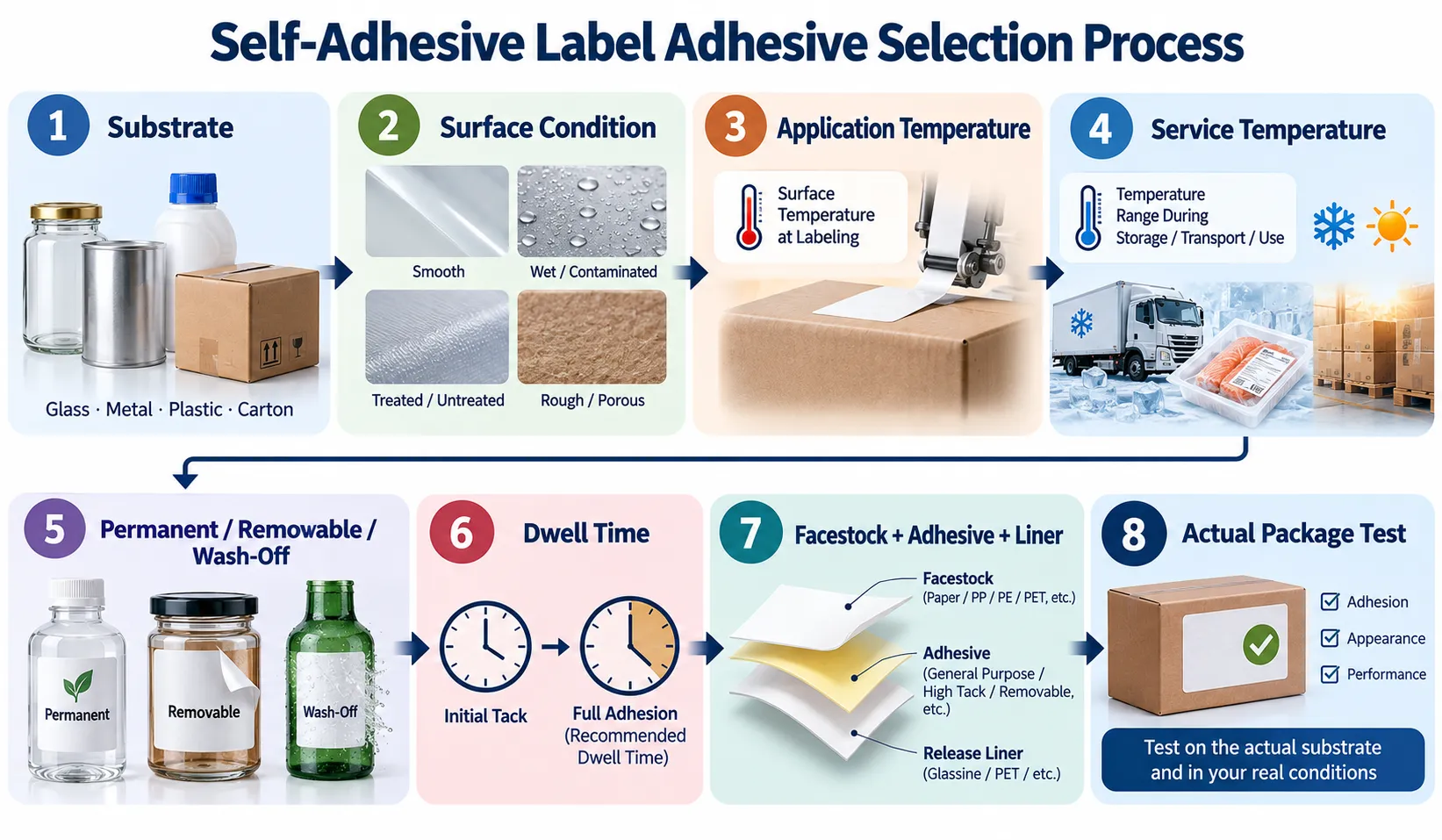
A useful workflow is:
1. Identify the substrate
Glass, PET, HDPE, PP, metal, carton or another surface.
2. Review the surface condition
Smooth, rough, treated, untreated, coated, wet or dusty.
3. Confirm application temperature
The temperature at which labeling actually occurs.
4. Confirm service conditions
Temperature, moisture, humidity and expected storage environment.
5. Define removal behavior
Permanent, removable, repositionable or wash-off.
6. Select the complete construction
Facestock + adhesive + release liner.
7. Test the material
Use representative samples on the actual package whenever possible.
This approach reflects YG Group's broader R&D structure, which includes testing, material analysis, adhesive formulation and application evaluation rather than relying only on one published peel value.
Common Adhesive Selection Mistakes
Testing on the Wrong Surface or at the Wrong Temperature
A standard panel or room-temperature test may not represent the actual packaging process.
Treating Removable and Wash-Off as the Same Requirement
They use different removal mechanisms and should be evaluated separately.
Testing the Adhesive Without the Complete Label
Facestock stiffness, label dimensions, curvature and application method can all affect final performance.
What Information Should Buyers Provide?
For adhesive and label-material evaluation, provide:
- Substrate material
- Surface condition or treatment
- Container shape and curvature
- Facestock preference, if known
- Label dimensions
- Application temperature
- Service temperature
- Refrigerated or frozen conditions
- Moisture or condensation exposure
- Permanent / removable / wash-off requirement
- Expected dwell time before removal
- Printing process
- Manual or automatic labeling
- Estimated annual quantity
For new projects, sending an actual container, substrate sample, photo or existing label specification can make the evaluation more representative.
Frequently Asked Questions
What is the most important factor when choosing a label adhesive?
Start with the actual substrate and labeling conditions. The adhesive needs to establish suitable contact at the application temperature and remain suitable during the intended service environment.
What is the difference between application temperature and service temperature?
Application temperature is the temperature when labeling occurs. Service temperature is the temperature range the label experiences afterward during storage, transport and use.
Which adhesive should I consider for freezer labels?
It depends on when the product becomes cold. Direct low-temperature labeling may require a freezer-grade adhesive, while room-temperature labeling followed by freezing places greater emphasis on service-temperature performance.
Are removable and wash-off adhesives the same?
No. Removable adhesives are intended for controlled peeling from compatible surfaces. Wash-off systems are designed to release under defined washing or recycling conditions.
Which adhesive is suitable for PE or PP containers?
Untreated PE and PP generally have lower surface energy than glass or metal. Adhesive selection should therefore be confirmed on the actual container, including surface treatment, curvature and service conditions.
Does dwell time affect removable-label performance?
Yes. Bond strength can develop over time, so removal behavior may differ between short- and long-term applications.
Does facestock affect adhesive selection?
Yes. Facestock stiffness, flexibility and label dimensions influence the stress placed on the adhesive. Facestock and adhesive should therefore be evaluated as part of the same construction.
Need Help Selecting a Label Adhesive?
There is no single adhesive that is best for every self-adhesive label.
The correct construction depends on the substrate, surface condition, application temperature, service environment and required removal behavior.
YG Group can review:
Substrate → Surface Condition → Application Temperature → Service Temperature → Permanent / Removable / Wash-Off → Dwell Time → Facestock → Label Size → Quantity
and narrow the options for sample evaluation.