

Which PP & Synthetic Label Facestock Is Right for Your Application?



Choosing a film label material is not simply about comparing film thickness or selecting one type of PP.
The right facestock depends on what the finished label needs to do.
A logistics label may require direct thermal printing. A transparent cosmetic bottle may need a clear no-label appearance. A consumer product may need an opaque white glossy surface, while promotional packaging may rely on metallic or holographic effects.
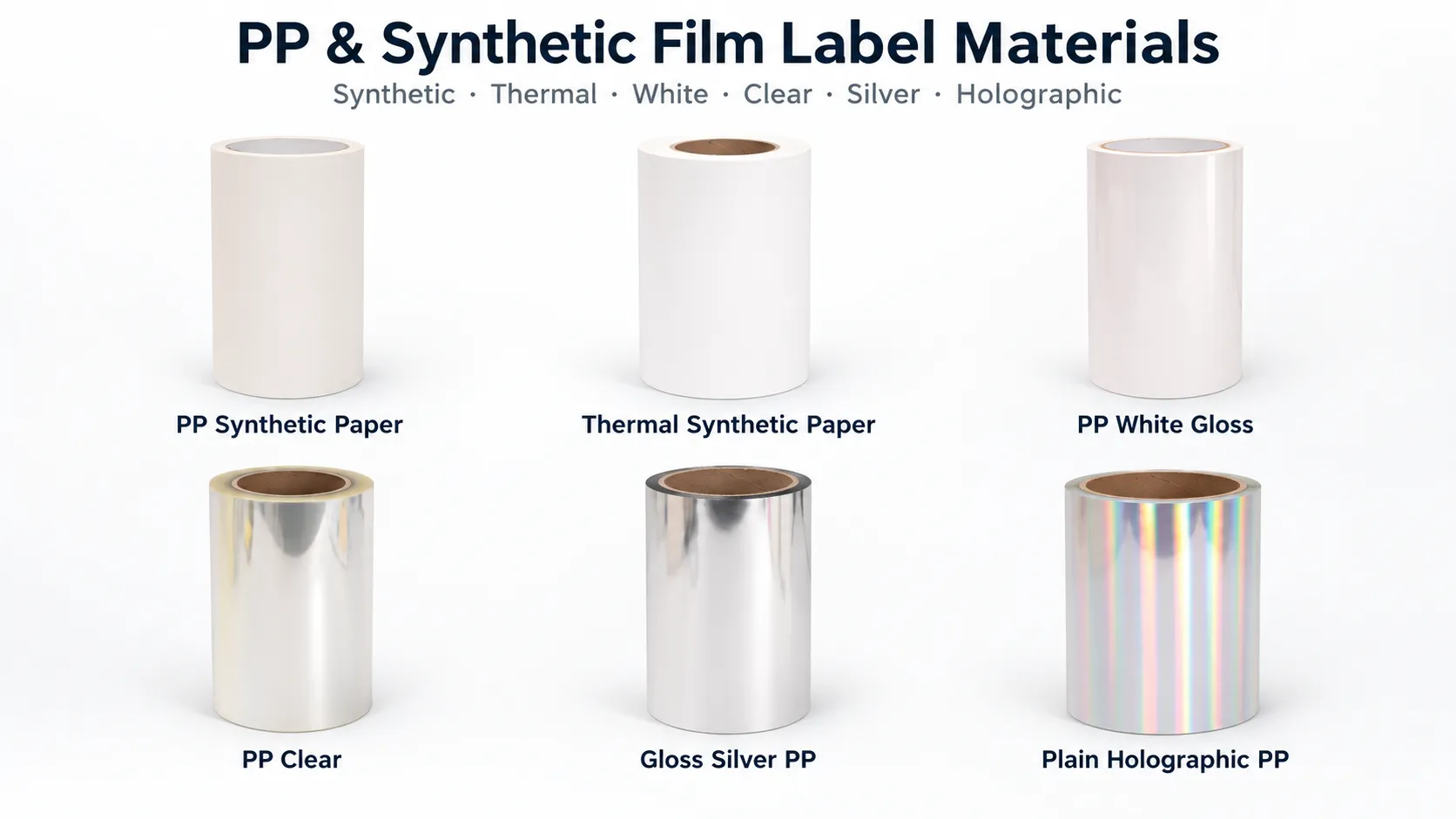
YG Group's current Film Raw Material range includes six main facestock directions:
PP Synthetic Paper · Thermal Synthetic Paper · PP White Gloss · PP Clear · Gloss Silver PP · Plain Holographic PP
Each serves a different printing, appearance or packaging requirement.
A practical selection process is:
Printing Requirement → Appearance → Application → Adhesive → Release Liner → Final Construction
Quick Answer: Which Film Label Material Should You Start With?
| Main Requirement | Starting Facestock |
|---|---|
| General-purpose synthetic label facestock | PP Synthetic Paper |
| Direct thermal printing without ribbon | Thermal Synthetic Paper |
| Opaque white glossy appearance | PP White Gloss |
| Transparent / no-label appearance | PP Clear |
| Metallic silver appearance | Gloss Silver PP |
| Decorative holographic appearance | Plain Holographic PP |
These are starting directions, not complete label specifications.
The six names in this guide primarily describe the facestock direction. The final commercial self-adhesive construction may also include different pressure-sensitive adhesives and release liners.
The buyer should therefore select the facestock first, then confirm:
Adhesive + Liner + Printing + Application Surface + Service Conditions
1. PP Synthetic Paper — General-Purpose Synthetic Label Facestock
PP Synthetic Paper is the broadest starting option among these six product families.
It is useful when the label requires a synthetic facestock but does not specifically need:
- Direct thermal printing
- Transparent appearance
- Metallic silver appearance
- Holographic decoration
- A white glossy packaging surface
YG Group's current range includes 54 μm and 75 μm synthetic-paper facestocks, with different adhesive constructions available according to the project.
Typical starting applications include:
- Product identification
- Food-packaging labels
- Household-product labels
- Selected logistics labels
Important: “General-purpose” here means PP Synthetic Paper is the broadest starting option among these six facestocks. It does not mean one PP Synthetic Paper construction is suitable for every substrate, printing method or service environment.
When Should Buyers Start with PP Synthetic Paper?
Consider it when the main requirement is a synthetic label facestock, and the final decision will depend more on:
Printing + Adhesive + Substrate + Service Conditions
than on a special visual or direct-thermal requirement.
2. Thermal Synthetic Paper — For Direct Thermal Printing
Thermal Synthetic Paper addresses a much more specific printing requirement.
Its main distinction is:
Thermal Synthetic Paper is designed for direct thermal printing without a ribbon.
YG Group's current product family uses a 75 μm thermal synthetic facestock, with several adhesive options for different labeling conditions.
Typical applications include:
- Shipping labels
- Barcode labels
- Warehouse identification
- Inventory labels
- Selected cold-chain logistics labels
The choice between PP Synthetic Paper and Thermal Synthetic Paper should therefore begin with the printing method, not film thickness.
Need ribbon-free variable-data printing? Start with Thermal Synthetic Paper.
3. PP White Gloss (Gloss White PP) — For an Opaque White Glossy Surface
PP White Gloss is selected primarily when the packaging design requires an opaque white and glossy label surface.
Buyers may also search for this material as Gloss White PP.
YG Group's current range includes a 60 μm PP White Gloss facestock in pressure-sensitive label constructions.
Compared with clear, silver or holographic facestocks, its main difference is a consistent white printing base.
It can be considered for:
- Cosmetic packaging
- Personal-care labels
- Food packaging
- Household products
- General consumer-product labels
Choose PP White Gloss When:
The package requires:
Opaque White Background + Glossy Surface + Printed Branding
rather than transparency or a metallic visual effect.
The actual printing process should still be confirmed for the selected grade.
4. PP Clear (Clear PP) — For Transparent and No-Label-Look Packaging
PP Clear is selected when transparency is part of the packaging design.
Buyers may also search for this material as Clear PP label material.
YG Group's current range uses a 50 μm PP Clear facestock in self-adhesive constructions.
It can be considered when:
- The container should remain visible
- Product color should show through the label
- Transparent packaging is part of the design
- A no-label-look appearance is required
However, facestock transparency alone does not determine the final result.
A no-label look also depends on:
Adhesive Clarity + Container Surface + Printing Coverage + Application Quality + Label-Edge Visibility
The complete clear-label construction should therefore be evaluated rather than the film alone.
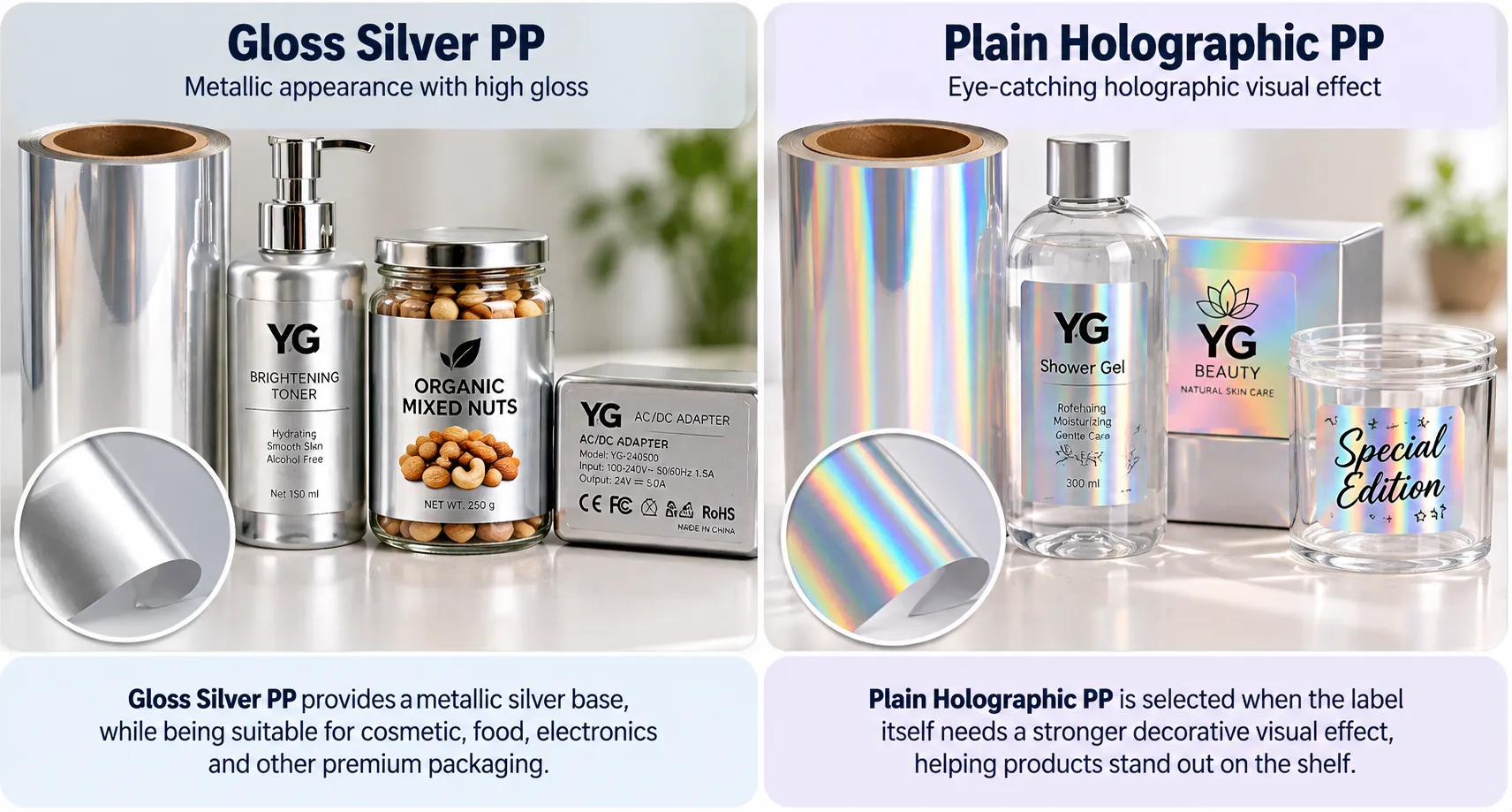
5. Gloss Silver PP — For Metallic Silver Packaging Effects
Gloss Silver PP is selected mainly when the facestock itself needs to contribute a metallic silver effect to the design.
YG Group's current range uses a 50 μm Gloss Silver PP facestock with pressure-sensitive adhesive options.
Unlike PP White Gloss, where the artwork sits on a white background, Gloss Silver PP allows the metallic base to become part of the printed design.
Typical applications may include:
- Cosmetic labels
- Food packaging
- Electronic-product labels
- Decorative consumer packaging
Choose Gloss Silver PP When:
The design requires:
Metallic Silver Base + Printed Graphics
rather than a white or transparent background.
Artwork and ink coverage should be tested on the actual material because the metallic base may influence the finished appearance.
6. Plain Holographic PP — For Decorative Label Effects
Plain Holographic PP is the most design-driven facestock among these six options.
YG Group's current range uses a 50 μm Plain Holographic PP facestock in self-adhesive constructions.
It can be considered for:
- Promotional labels
- Decorative packaging
- Cosmetics
- Gift packaging
- Retail branding
- Limited-edition packaging
The main reason to select it is the holographic surface effect.
Material selection should therefore focus on:
Design Intent + Printing Method + Converting Process + Final Package Appearance
rather than treating it as a general-purpose PP facestock.
Compare the Six Film Label Facestocks
| Material | Main Selection Reason | Current Facestock Example | Typical Starting Application |
|---|---|---|---|
| PP Synthetic Paper | General-purpose synthetic label facestock | 54 / 75 μm | Product, food, household, selected logistics labels |
| Thermal Synthetic Paper | Direct thermal printing | 75 μm | Logistics, barcode, warehouse, cold chain |
| PP White Gloss | Opaque white glossy surface | 60 μm | Consumer and packaging labels |
| PP Clear | Transparent appearance | 50 μm | Clear packaging and no-label-look applications |
| Gloss Silver PP | Metallic silver appearance | 50 μm | Metallic and decorative packaging labels |
| Plain Holographic PP | Holographic visual effect | 50 μm | Promotional and decorative labels |
Specification note: These examples reflect YG Group's current product range as of October 2026. Final specifications and available constructions should be confirmed against the latest TDS before ordering.
The thicknesses above should not be compared as performance grades.
A 50 μm clear film and a 75 μm thermal synthetic facestock are designed for different printing and application requirements.
How to Choose the Right Film Label Facestock
The choice can usually be narrowed down with three questions.
1. Does the label require direct thermal printing?
Yes → Thermal Synthetic Paper
No → Continue
2. Is a specific visual appearance required?
Transparent → PP Clear
White Glossy → PP White Gloss
Metallic Silver → Gloss Silver PP
Holographic → Plain Holographic PP
3. No special thermal or visual requirement?
Start by evaluating:
PP Synthetic Paper
Then confirm the final adhesive, liner and printing construction.
This prevents buyers from trying to rank all six materials as if one were universally better.
Facestock Is Only One Part of the Label Construction
Selecting the facestock does not complete the label-material decision.
A pressure-sensitive construction normally includes:
Facestock + Adhesive + Release Liner
A suitable film may still behave differently when combined with another adhesive, liner or package surface.
The adhesive should therefore be confirmed according to:
Substrate → Surface Condition → Application Temperature → Service Temperature → Permanent / Removable Requirement
rather than selected only from the appearance of the facestock.
For buyers comparing PP with other film families, YG Group's PP vs. PE vs. PET Label Materials guide explains how package flexibility, conformability and dimensional stability influence facestock selection.
YG Group Selection Note
In practice, buyers often begin by specifying either the printing method or the required appearance.
But facestock alone does not determine the final label performance.
YG Group recommends confirming the actual:
Substrate + Printing System + Adhesive Requirement + Service Conditions
before finalizing the construction.
For replacement projects, an existing TDS or label sample is especially useful.
For new applications, an actual bottle, container or packaging sample can also help when appearance, curvature or adhesive performance needs to be evaluated.
YG Group Product Evaluation
For new label projects, YG Group can review the facestock, adhesive and release liner as one construction rather than evaluating the face material alone.
Where relevant to the application, evaluation can include areas such as:
Actual Package Testing
- Plastic bottle
- Glass bottle
- Carton
- Cold-chain pack
Material / Adhesive Testing
- Tack Test
- Peel Adhesion Test
- Holding Power
- Application Evaluation
This is particularly useful when the project involves lower-surface-energy plastics, small-diameter containers, cold-chain conditions or a new adhesive construction.
For a new project, providing a TDS, existing label sample or actual package can make material matching and sample evaluation more relevant.
What Should Buyers Provide Before Ordering?
For a more accurate material recommendation, provide:
- Required facestock or desired appearance
- Printing method
- Ink system
- Application substrate
- Application temperature
- Service temperature
- Adhesive requirement
- Release-liner preference
- Roll width
- Roll length
- Core size
- Estimated annual quantity
For replacement projects, also provide:
Existing TDS / Product Code / Physical Sample / Finished Label
YG Group Film Raw Material Range
These six products form part of YG Group's broader Film Raw Material portfolio.
Instead of beginning with one universal film, buyers can start from the real requirement:
General Synthetic → Thermal → White → Clear → Silver → Holographic
and then match the selected facestock with the appropriate adhesive, liner and converting requirements.
For PP Synthetic Paper specifically, YG Group also manufactures base material in-house.
Detailed information about its 40,000-ton annual PP synthetic paper base-material capacity, 8.7 m Brückner line and wide-web production capability is covered separately in PP Synthetic Paper Manufacturer with 40,000 Tons Annual Capacity.
This keeps this guide focused on film label facestock selection rather than repeating manufacturing information.
Frequently Asked Questions
What is the difference between PP Synthetic Paper and Thermal Synthetic Paper?
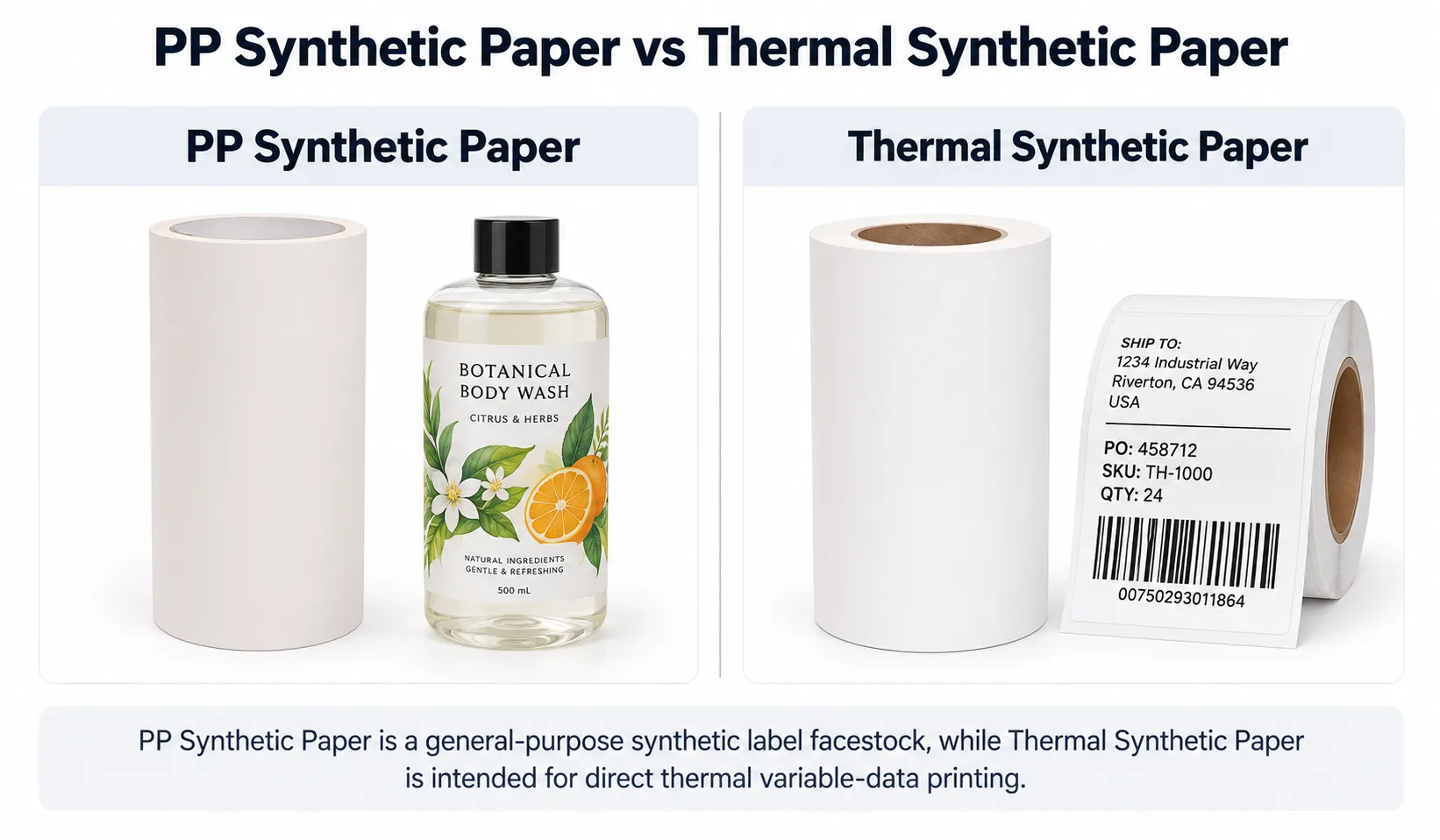
PP Synthetic Paper is a general-purpose synthetic label facestock, while Thermal Synthetic Paper is designed for direct thermal printing.
If ribbon-free barcode or variable-data printing is required, Thermal Synthetic Paper is the more relevant starting point.
Which material should I use for transparent labels?
Start with PP Clear.
The final transparent appearance also depends on adhesive clarity, container surface, print coverage and application quality.
What is the difference between PP White Gloss and PP Clear?
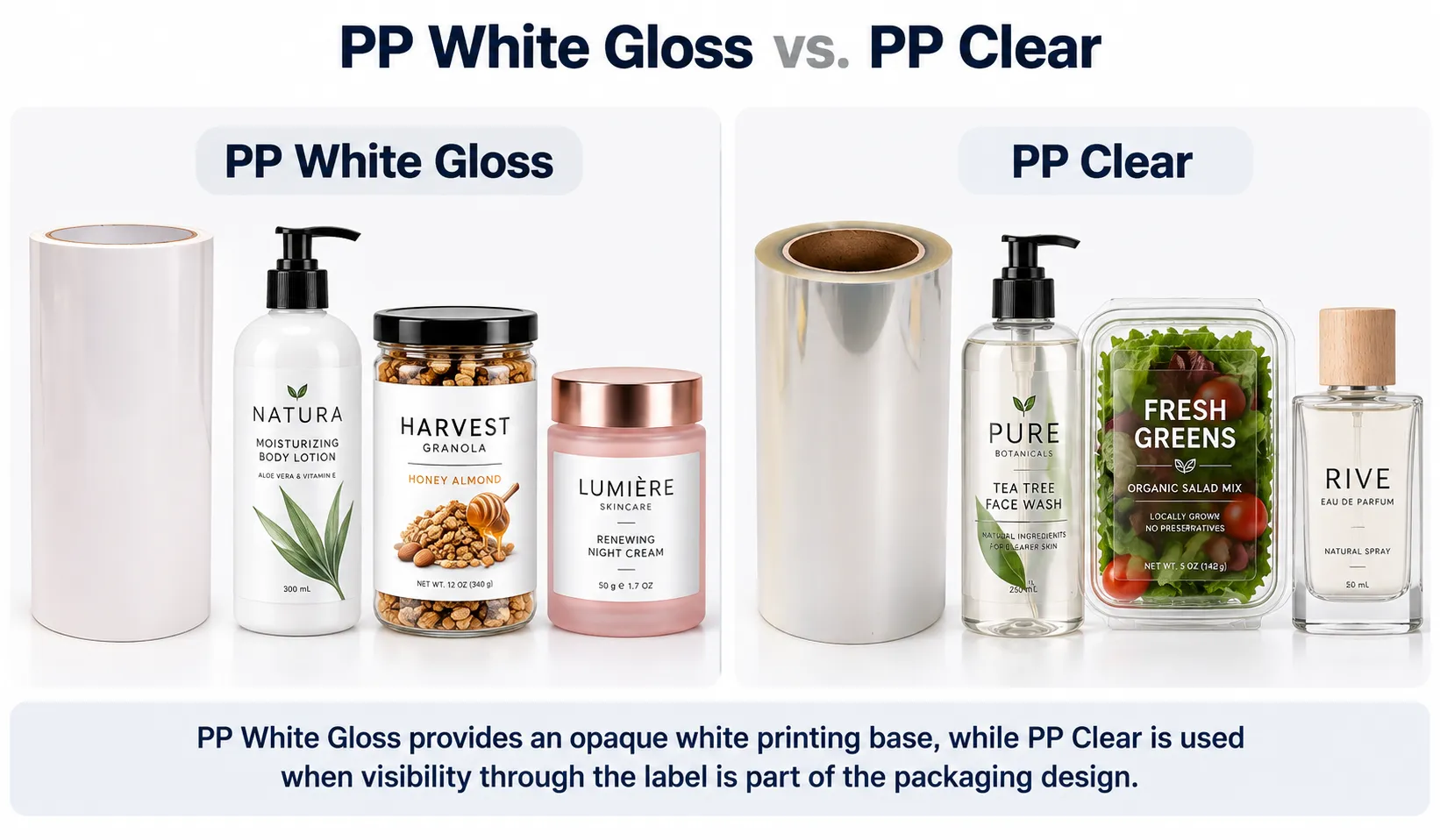
PP White Gloss provides an opaque white glossy printing surface.
PP Clear allows the package or product to remain visible through the label.
The choice is primarily driven by the required packaging appearance.
What is the difference between PP White Gloss and Gloss Silver PP?
PP White Gloss provides a white printing base, while Gloss Silver PP provides a metallic silver base.
The correct choice depends on the desired visual result and printing design.
When should I use Plain Holographic PP?
Use Plain Holographic PP when the holographic effect itself is part of the packaging or promotional design.
It is more design-driven than a general-purpose synthetic facestock.
Are all six materials available with the same adhesive?
No.
Available adhesive constructions vary by facestock family. The final adhesive should be matched to the substrate, application temperature and service conditions.
Can YG Group supply jumbo or finished rolls?
Supply format depends on the selected construction and project requirements.
Provide the required roll width, roll length, core size and quantity when requesting a quotation.
What information should I send for a quotation?
Provide:
Required Facestock / Appearance → Printing Method → Substrate → Adhesive → Liner → Roll Size → Quantity
For replacement projects, also send the current TDS or material sample.
Need Help Choosing the Right Film Label Material?
Not sure which facestock fits your project?
Send YG Group:
Application → Required Appearance → Printing Method → Substrate → Adhesive Requirement → Roll Size → Quantity
YG Group can then narrow the available facestock, adhesive and liner combinations for sample evaluation and quotation.