
Adhesive Tape Peel Strength Test: 90° & 180° Methods
How strong is the bond between adhesive tape and a surface?
An adhesive tape peel strength test measures the force needed to remove tape from a bonded surface. It helps evaluate the bonding performance of pressure-sensitive adhesive tapes.
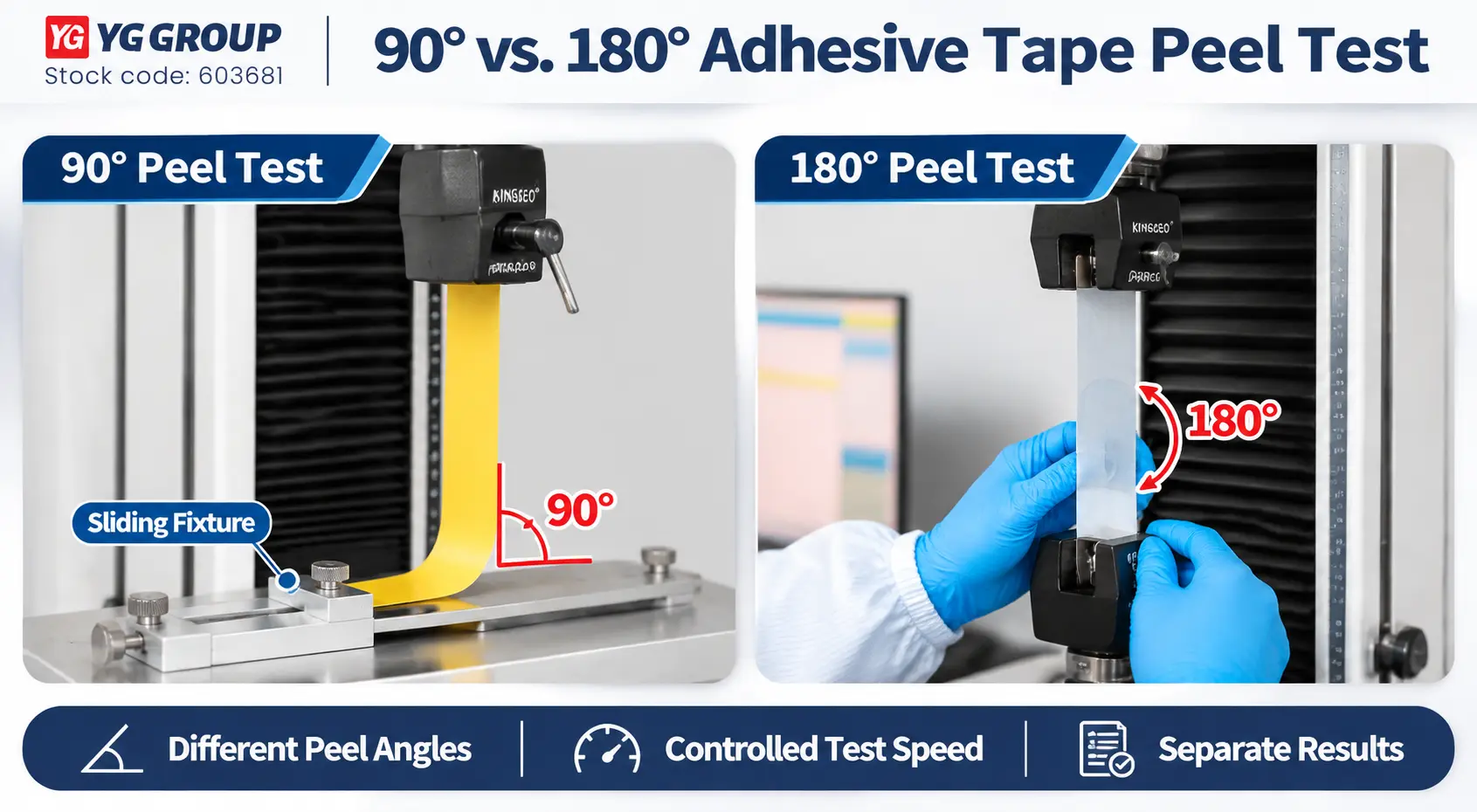
Two common configurations are 90° and 180° peel tests. However, they use different peeling angles and test setups.
YG Group demonstrates both methods using a tensile testing machine. This guide explains the test principles, laboratory procedures and key factors affecting peel strength.
Quick Answer: What Is an Adhesive Tape Peel Strength Test?
A peel strength test measures the force required to separate adhesive tape from a specific surface at a defined angle and speed.
The result reflects the peel adhesion between the tape and substrate.
Two common configurations include:
- 90° Peel Test: The tape separates from the test panel at a right angle.
- 180° Peel Test: The tape folds back over itself during removal.
The peel strength of adhesive tape depends on its adhesive formulation, backing material, substrate and test conditions.
Therefore, consistent preparation and testing are essential for meaningful results.
90-Degree vs. 180-Degree Peel Test: What Is the Difference?
Both methods evaluate peel adhesion. However, their test geometries are different.
90° Peel Test
In a 90 degree peel test, the tape separates from the test panel at a right angle.
A dedicated fixture maintains a constant 90° angle throughout the test.
The fixture controls the relative movement of the tape and test panel. This helps maintain the required peeling geometry.
180° Peel Test
In a 180 degree peel test, the tape folds back over itself during removal.
The tensile testing machine pulls the free end in the opposite direction from the original application.
This method measures the force required to separate the tape from the test panel at 180°.
90° vs. 180° Peel Test Comparison
| Comparison | 90° Peel Test | 180° Peel Test |
|---|---|---|
| Peel Angle | 90° | 180° |
| Tape Direction | Perpendicular to panel | Folded back over itself |
| Fixture | 90° peel fixture | 180° peel fixture |
| YG Test Speed | 300 mm/min | 300 mm/min |
| Measurement | Peel force | Peel force |
Different peeling angles create different test conditions.
Therefore, report the two results separately. Do not treat them as directly interchangeable.
Watch the YG Group 90° & 180° Peel Strength Test
In this video, YG Group demonstrates both peel test configurations using an electronic tensile testing machine.
Follow the laboratory process:
Equipment Calibration → Specimen Preparation → Standard Application → Dwell → Clamping → Peel Testing → Data Recording
The demonstration shows how controlled preparation and testing conditions support adhesive performance evaluation.
Test Conditions Used in the YG Demonstration
The following table summarizes the actual parameters specified in the YG video.
| Test Parameter | YG Demonstration Condition |
|---|---|
| Reference Standard | GB/T 2792-2014 |
| Environment | 23°C ± 1°C / 50% RH ± 5% |
| Specimen Conditioning | At least 2 hours |
| Specimen Size | 25 × 300 mm |
| Test Panel | Mirror-polished 304 stainless steel |
| Standard Roller | 2 kg |
| Rolling | 2 back-and-forth passes |
| Dwell Time After Application | 20 minutes |
| Peel Angles | 90° and 180° |
| Test Speed | 300 mm/min |
| Reporting Format | N/25 mm (YG demonstration format) |
Important Note on Standard Compliance
These parameters describe YG Group's video demonstration. They do not establish full compliance with GB/T 2792-2014.
The standard specifies different requirements for conditioning, specimen width, cleaning and measurement.
For example:
- Condition the tape roll and test panels for at least 24 hours.
- Use a standard specimen width of 24 ± 0.5 mm.
- Prepare at least three specimens per test group.
- Complete specimen preparation and testing within 1 minute under the standard procedure.
- Report any selected longer dwell time separately.
The standard also specifies the test panel surface condition and cleaning procedure.
The YG demonstration uses 2-hour conditioning, 25 mm-wide specimens, ethanol cleaning and a 20-minute dwell time.
A longer dwell time is permitted when specifically selected and reported. However, the other differences must also be considered.
Therefore, describe this video as a laboratory demonstration referencing GB/T 2792-2014, rather than a complete standard-compliance test.
How Is an Adhesive Tape Peel Strength Test Performed?
The YG Group demonstration follows six main steps.
Step 1: Equipment Calibration
Switch on the electronic tensile testing machine and allow it to warm up.
Then zero the force and travel measurements.
Check the test speed, travel range and sampling settings before testing.
Step 2: Specimen Preparation
Remove 3–6 outer layers of tape.
Cut the specimens to 25 mm × 300 mm.
Clean the test panel with anhydrous ethanol and lint-free wipes at least three times.
Allow the ethanol to evaporate completely.
Avoid touching the adhesive surface or test panel by hand.
Step 3: Standard Application and Dwell
Apply the tape flat to the stainless steel panel.
Use a 2 kg standard roller to roll back and forth twice at a constant speed.
Do not apply additional pressure or lift the roller.
Avoid air bubbles, wrinkles and uneven contact.
Then leave the specimens for 20 minutes under controlled laboratory conditions.
Prepare parallel specimens for each test angle according to the video procedure.
Step 4: Clamping and Alignment
Install the specimen in the corresponding 90° or 180° peel fixture.
Before the 90° test, check the fixture's sliding assembly and traction cord.
This specific check is not required for the 180° setup.
Next, clamp the free end of the tape and confirm the correct test panel orientation.
Maintain the required peel angle throughout the test.
Step 5: Perform the 90° and 180° Peel Tests
Set the tensile testing machine to:
300 mm/min
First, perform the 90° peel test.
Allow the machine to run automatically and record the peel force continuously.
Then replace the specimen and perform the 180° peel test at the same speed.
Avoid manual pulling or external interference.
Step 6: Process and Record the Results
Review the force curve after each test.
For the YG demonstration, exclude abnormal fluctuations at the beginning and end.
Calculate the average force over the stable middle section.
Record the 90° and 180° results separately.
Always identify the specimen width, peel angle, speed and test conditions.
How Are Peel Strength Results Measured?
The tensile testing machine records the force required to separate the tape from the test panel.
For the YG demonstration, the average force over the stable middle section represents the reported result.
GB/T 2792-2014 specifies N/cm as its reporting unit. YG's video uses N/25 mm for its 25 mm-wide specimens.
For conversion:
N/cm = Measured Force (N) ÷ Specimen Width (cm)
For example, a 10 N peel force on a 25 mm-wide specimen equals 4 N/cm.
Always identify the specimen width, peel angle and test conditions when reporting results.
What Factors Affect Peel Strength?
Several factors can influence peel adhesion:
- Substrate: Dust, oil and surface roughness affect adhesive contact.
- Application Pressure: Uneven rolling can create inconsistent bonding.
- Dwell Time: Adhesion may change as the adhesive develops contact.
- Peel Angle and Speed: Different test conditions can produce different results.
- Temperature and Humidity: Environmental conditions may affect adhesive behavior.
Therefore, use consistent preparation and controlled testing conditions.
Which Standards Are Used for Peel Adhesion Testing?
Several standards cover adhesive tape peel testing.
| Standard | Test Scope |
|---|---|
| GB/T 2792-2014 | 180° methods and 90° method in Annex B |
| ASTM D3330/D3330M | Includes specific 90° and 180° methods |
| ISO 29862:2024 | Four main 180° methods and 90° variations in Annex B |
These standards share a similar testing purpose. However, their procedures are not fully identical.
GB/T 2792-2014 modifies ISO 29862:2007, not the 2024 edition. ASTM methods also have different applications for single-coated and double-coated tapes.
Therefore, confirm the applicable method and specimen requirements before comparing test reports.
Important: YG's video demonstrates a laboratory procedure referencing GB/T 2792-2014. It should not be described as a fully standard-compliant test without verifying all requirements.
Official references:
YG Group Adhesive Tape Products
YG Group supplies adhesive tapes for packaging, masking, mounting and industrial applications.
Examples include:
- Double-Sided Tissue Tape for general bonding and mounting.
- Double-Sided PP Tape for labels, nameplates and automotive trim.
Peel adhesion is one of the technical properties used to evaluate these products.
However, always check the relevant TDS because testing conditions may differ.
For another important adhesive performance indicator, read our adhesive tape holding power test guide.
Frequently Asked Questions
1. What is adhesive tape peel strength?
It measures the force required to separate adhesive tape from a bonded surface under defined conditions.
2. What is the difference between 90° and 180° peel testing?
A 90° test removes tape at a right angle. A 180° test folds the tape back over itself.
3. What is the standard peel test speed?
YG uses 300 mm/min in this demonstration. Other specifications may require different speeds.
4. What unit is used for peel strength?
GB/T 2792-2014 uses N/cm. YG's video demonstration uses N/25 mm for its 25 mm-wide specimens.
5. Does higher peel strength always mean better tape?
No. The required peel strength depends on the application. Masking tape, for example, may require controlled adhesion and clean removal.
6. Can 90° and 180° results be compared directly?
No. Different peeling geometries produce different test conditions. Report them separately.
Need Adhesive Tape Technical Support?
YG Group supports adhesive tape evaluation through laboratory testing, product information and sample assessment.
Share your requirements:
Tape Type → Substrate → Peel Angle → Test Standard → Required Performance
Contact YG Group for product specifications, TDS and sample evaluation.