

Double-Sided Carpet Tape in Brazil: Crepe Paper vs. Cloth Tape



Choosing double-sided carpet tape is not simply about finding the strongest adhesive. For temporary carpet installation, buyers also need to consider floor compatibility, installation efficiency, removal requirements, backing structure, and the size of the area being covered.
These factors are particularly relevant for exhibitions, events, commercial spaces, and other temporary flooring projects. In Brazil, this type of product is often described using terms such as “fita dupla face para carpete” or “fita dupla face de papel crepe.”
YG Group offers different tape constructions for these requirements, including double-sided crepe paper tape and cloth-backed carpet tape.
Both can support temporary fixing, but they differ in backing structure and application focus.
Quick Answer: For temporary carpet fixing, exhibition flooring, and large-area carpet installation, Double Sided Crepe Paper Tape is the more application-focused choice. Cloth Carpet Tape is better suited when broader mounting, hanging, object fixation, or positioning applications are also required.

Why Is Double-Sided Carpet Tape Relevant for Temporary Flooring in Brazil?
Brazil has a substantial exhibition and business-events market. According to UBRAFE (Brazilian Union of Trade Fairs and Business Events), the country hosts more than 2,000 fairs and events annually, creating ongoing demand for temporary venue setup, exhibition stands, commercial displays, and related installation materials
Temporary flooring is one part of this setup process. Carpets may need to be installed quickly, remain securely positioned throughout an event, and then be removed after a limited period.
Typical applications include:
- Exhibition stands
- Trade shows
- Events
- Commercial displays
- Temporary interior decoration
- Hotels and event venues
- Large-area temporary flooring
In the Brazilian market, paper-backed double-sided tapes are available for temporary carpet fixing and related applications. Products in this category may be described as “fita dupla face para carpete” or “fita dupla face de papel crepe,” giving buyers familiar local terminology when sourcing carpet-fixing solutions.
For these projects, adhesive strength is only one selection factor.
Installers also need to consider how easily the tape can be handled across a large floor area, how it interacts with both the carpet backing and the floor surface, and how the tape performs when the temporary installation is removed.
This makes application-specific product selection especially important.
What Are the Two Main Carpet Tape Options?
YG offers two relevant constructions for temporary fixing: crepe paper-backed tape and woven cloth-backed tape.
Both are double-sided and use a yellow glassine release liner, but their backing materials and application focus are different.
Double-Sided Crepe Paper Tape
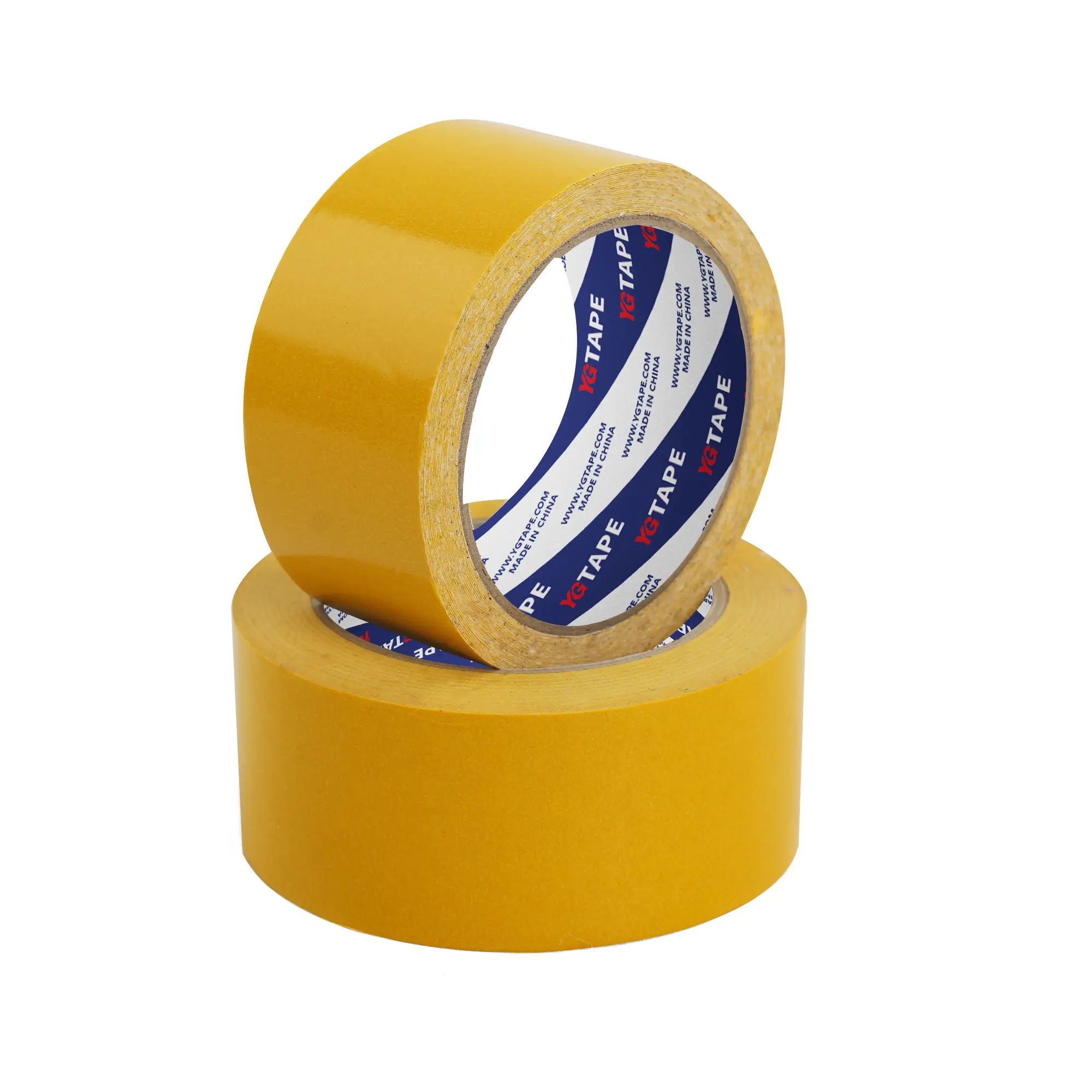
YG Double Sided Crepe Paper Tape uses crepe paper as the backing, with rubber adhesive coated on both sides and a yellow glassine release liner.
Its key features include:
- Easy to tear and cut
- Strong holding performance
- Clean removal under suitable application conditions
- Flexible and conformable crepe paper backing
- Suitable for a wide range of floor surfaces
Its main applications are closely related to flooring:
- Carpet fixing on different floor surfaces
- Exhibition and event carpet installation
- Large-area carpet installation
- Temporary carpet positioning and fixation
The crepe paper backing makes the tape easy to handle during repetitive manual installation.
For example, when carpet is being laid across an exhibition booth or event area, installers may need to place and cut multiple tape sections. A flexible backing that can be torn easily can simplify this process.
Cloth Carpet Tape
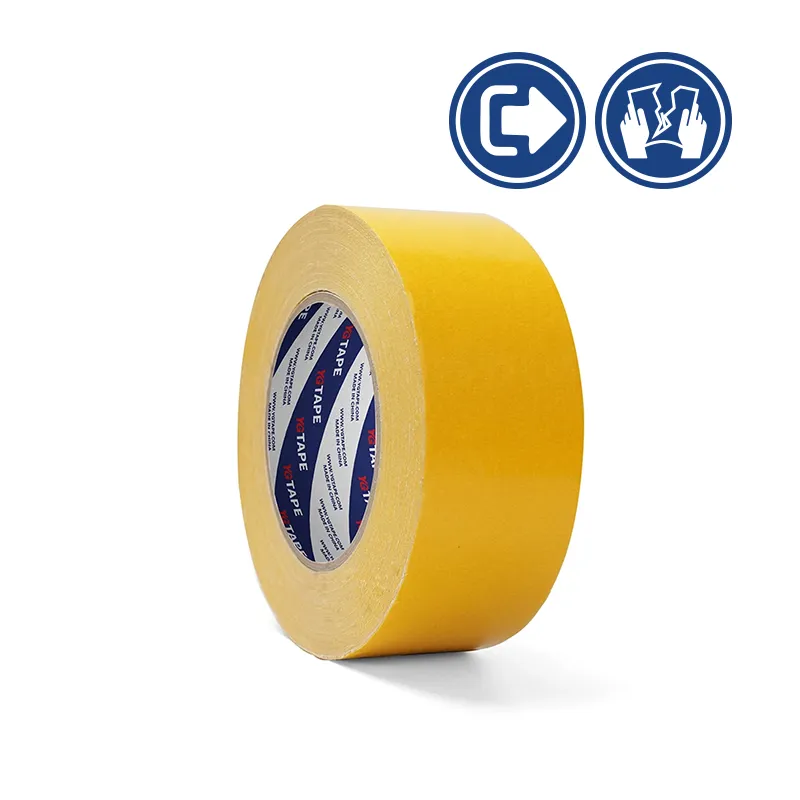
YG’s Double Sided Yellow Carpet Tape is a cloth-backed tape made with woven cloth, natural rubber adhesive on both sides, and a yellow glassine liner.
In this guide, we refer to this construction as cloth carpet tape.
Its key features include:
- Strong initial tack
- Moderate adhesion
- Clean removal for short-term use
- Easy hand tear
- Yellow glassine liner
Its application range extends beyond carpet installation.
Typical uses include:
- Object fixation
- Hanging applications
- Tool-free mounting
- General bonding
- Temporary carpet hold-down
- Engraving and positioning
This makes the cloth-backed version useful when one tape needs to support several mounting and positioning tasks rather than being used mainly for flooring.
Crepe Paper vs. Cloth Carpet Tape: Key Differences
The main difference is not simply which tape is stronger.
The two products use different backing structures and are positioned around different application priorities.
| Selection Factor | Double-Sided Crepe Paper Tape | Cloth Carpet Tape |
| Backing | Crepe paper | Woven cloth |
| Adhesive | Rubber adhesive | Natural rubber adhesive |
| Liner | Yellow glassine | Yellow glassine |
| Initial Tack | Strong | Strong |
| Manual Application | Easy to tear and cut | Easy hand tear |
| Removal | Clean removal under suitable conditions | Clean removal for short-term use |
| Primary Application Focus | Carpet installation | Mounting and positioning |
| Exhibition Carpet | Core application | Suitable for temporary hold-down |
| Large-Area Carpet Installation | Application-focused | Depends on project requirements |
| Object Fixation | Not the primary focus | Core application |
| Engraving & Positioning | Not a core application | Suitable |
| Best Selection Direction | Temporary and large-area carpet installation | Multi-purpose mounting and positioning |
The key difference is therefore application focus.
Crepe paper tape is centered on carpet fixing and temporary flooring, while cloth-backed tape provides broader mounting and positioning versatility.
This comparison should be treated as application guidance rather than a ranking of which product is better.

Which Carpet Tape Should You Choose?
The right choice depends on what the tape needs to do during the actual project.
Choose Crepe Paper Tape When...
Double-sided crepe paper tape is a suitable starting point when:
- Carpet fixing is the main application
- Carpet needs to be installed temporarily
- Exhibition or event flooring is involved
- A large floor area needs to be covered
- Easy tearing and cutting are important
- Different compatible floor surfaces may be encountered
- Clean removal under suitable conditions is required
For contractors whose main task is temporary carpet installation, the application focus of crepe paper tape is particularly relevant.
Its backing, handling characteristics, and adhesive configuration are designed around flooring applications rather than general object mounting.
Choose Cloth Carpet Tape When...
Cloth carpet tape may be more appropriate when:
- Carpet fixing is only one of several applications
- Objects also need to be temporarily fixed
- Hanging applications are required
- Tool-free mounting is important
- General bonding is needed
- Engraving or positioning is part of the work
- A woven cloth backing is preferred
This gives the cloth-backed product a broader application range for users who perform different mounting and positioning tasks.
For distributors, the two products can therefore serve different customer requirements rather than competing for exactly the same application.
What Should Buyers Check Before Choosing Carpet Tape?
Before purchasing carpet tape in volume, buyers should evaluate the complete installation rather than comparing only adhesive strength.
What Floor Surfaces Can Crepe Paper Carpet Tape Be Used On?
Double-sided crepe paper tape is suitable for a wide range of clean, dry floor surfaces.
Its rubber adhesive can support carpet fixing on both smooth and relatively uneven surfaces.
Depending on the actual floor finish, potential applications may include compatible:
- Tile flooring
- Smooth concrete
- Wood flooring
- Commercial flooring
- Other clean and dry floor surfaces

However, floor material alone does not determine whether a tape is suitable.
Coatings, polishing treatments, paint, aging, contamination, and surface sensitivity can all affect adhesion and removal.
For sensitive, newly finished, coated, or specially treated flooring, a small-area test should always be carried out before full installation.
Check the Carpet Backing
The floor is only one side of the bonding system.
The underside of the carpet also affects adhesive contact.
Different carpets may use different backing materials, textures, and surface structures. Buyers should therefore evaluate the actual carpet rather than assuming that all carpet backings will perform in the same way.
Consider Installation Duration
Temporary carpet installation may range from a short event to a project lasting several days or longer.
Pressure-sensitive adhesive behavior can change as bonding time increases.
If clean removal is important, the intended installation period should therefore be included in the product test.
Consider Installation Area
Large-area carpet installation has different handling requirements from small-scale rug or mat fixing.
For larger projects, buyers should consider:
- Tape width
- Roll length
- Number of tape joints
- Installation speed
- Manual tearing or cutting requirements
An easy-to-handle backing can become increasingly useful as the total installation area grows.
Check Removal Requirements
Clean removal is particularly important for temporary exhibitions and events where the original floor needs to remain in good condition after the carpet is removed.
However, residue-free removal should not be treated as an unconditional guarantee.
Actual results can vary according to:
- Floor material
- Surface coating
- Application pressure
- Temperature
- Bonding time
- Installation duration
YG Selection Note: For temporary carpet installations, test the tape with both the actual carpet backing and the actual floor surface. Surface coating, roughness, bonding time, application pressure, and removal timing can all affect final performance.
Buyers looking for other mounting and bonding solutions can also explore the broader YG Double Sided Tape range.
Common Carpet Tape Selection Mistakes
Choosing Only by Adhesive Strength
The strongest adhesive is not automatically the best choice for temporary carpet installation.
Holding performance matters, but removal behavior, floor compatibility, carpet backing, and installation duration should also be considered.
The goal is to select enough holding performance for the application while maintaining appropriate removal behavior.
Assuming Clean Removal Works on Every Floor
A tape designed for short-term clean removal may still behave differently on different surfaces.
Painted, coated, polished, aged, or sensitive flooring can respond differently to pressure-sensitive adhesives.
Testing the actual floor before large-area installation helps reduce this risk.
Assuming All Carpet Tapes Have the Same Structure
Paper-backed and cloth-backed tapes may perform similar basic fixing tasks, but their construction and application focus are different.
Buyers should check:
- Backing material
- Adhesive type
- Release liner
- Removal positioning
- Intended application
This provides a more reliable basis for product selection than choosing by appearance alone.
FAQ
What Is Double-Sided Carpet Tape Called in Brazil?
In Brazil, this type of product may be referred to as fita dupla face para carpete. Crepe paper-backed versions may also be described as fita dupla face de papel crepe.
These terms are associated with double-sided tapes used for carpet fixing and temporary flooring applications.
Is Double-Sided Crepe Paper Tape Suitable for Exhibition Carpet Installation?
Yes.
It is designed for applications including exhibition and event carpet installation, large-area carpet laying, and temporary carpet positioning.
The crepe paper backing is flexible and easy to tear or cut, while the rubber adhesive provides the holding performance needed during installation.
Does Double-Sided Crepe Paper Tape Leave Residue?
It is designed for clean, residue-free removal under suitable application conditions.
However, actual removal performance can depend on the floor material, surface treatment, temperature, application pressure, and installation duration.
A small-area test is recommended before using the tape on sensitive or specially treated flooring.
Can Double-Sided Carpet Tape Be Used on Tile or Concrete?
It can be suitable for compatible tile, concrete, and other clean, dry floor surfaces.
The actual surface finish should always be checked before installation because coatings, treatments, and floor sensitivity can affect both adhesion and removal.
Why Use Crepe Paper Backing for Carpet Tape?
Crepe paper provides flexibility, conformability, and easy tearing and cutting during installation.
Combined with double-sided rubber adhesive, this creates a practical construction for temporary carpet fixing, exhibitions, events, and large-area carpet installation.
Which Is Better for Carpet Fixing: Crepe Paper or Cloth Tape?
There is no universal winner.
For temporary carpet fixing, exhibition flooring, event carpet installation, and large-area carpet laying, double-sided crepe paper tape is the more application-focused choice.
Cloth carpet tape is better suited when carpet fixing is combined with object fixation, hanging, mounting, engraving, or other positioning applications.
Is Cloth Carpet Tape Suitable for Temporary Mounting?
Yes.
YG Group cloth-backed tape is designed for short-term clean removal and can be used for temporary carpet hold-down as well as object fixation, hanging, mounting, and other general bonding applications.
Conclusion
Crepe paper and cloth-backed double-sided tapes can both support temporary fixing, but they are designed around different application priorities.
For buyers in Brazil whose primary requirement is temporary carpet installation, double-sided crepe paper tape is the more application-focused option. Its flexible crepe paper backing supports efficient manual handling, while rubber adhesive on both sides provides the holding performance needed for carpet fixing.
Cloth carpet tape remains a useful alternative when the same tape also needs to support object fixation, hanging, mounting, engraving, or positioning.
The selection rule is straightforward:
Choose crepe paper tape when carpet installation is the main task. Choose cloth carpet tape when broader mounting versatility is required.
For either option, the final selection should be based on the actual carpet, floor surface, installation duration, removal requirement, and working environment. A small-area test before full installation is recommended to confirm product suitability.
Need help choosing the right carpet tape for your application? Contact YG Group to discuss your carpet type, floor surface, installation duration, and roll size requirements.